
No More Hype: Turning AI into Better Quality and Outcomes
October 7, 2026 · NCQA Communications
Artificial intelligence is no longer a futuristic concept in healthcare. It is already helping clinicians document patient encounters, identify patients at risk for complications and streamline administrative work. Yet as adoption accelerates, healthcare leaders face a pressing question: How can organizations deploy AI responsibly while ensuring quality, safety and trust?
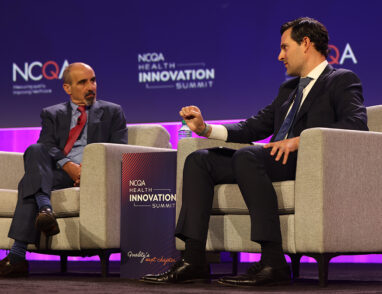
That question took center stage during a keynote session at NCQA’s Health Innovation Summit moderated by Ari Robicsek, MD, Chief Medical Officer and SVP, Quality Science and Innovation at NCQA. Joining the discussion were Shiv Rao, MD, Co-Founder and CEO of Abridge; Mark Sendak, MD, MPP, Co-Founder and CEO of Vega Health and former leader of AI initiatives at ONC; and Daniel Yang, MD, Vice President of AI and Emerging Technologies at Kaiser Permanente.
The panel agreed that the greatest challenge facing healthcare AI is no longer technological capability. It is creating the governance, accountability and trust structures needed to ensure AI improves quality rather than simply adding new layers of risk.
Key Takeaways From This Session
From Productivity Tool to Learning Health System
For Rao, the promise of AI extends far beyond reducing the burden of documentation. He described a vision in which AI helps create the long-discussed “learning health system,” where the right data and insights reach the right people at the right moment to improve outcomes and experiences. AI-powered assistants could synthesize clinical histories, identify care gaps and surface relevant information when it matters most.
The implications for quality improvement are significant. As health systems continue to pursue value-based care, AI could help bridge longstanding gaps between data collection and action, enabling organizations to identify risks earlier, intervene more effectively and continuously learn from patient interactions.
At the same time, Rao cautioned that realizing this vision requires more than powerful models. It requires robust infrastructure, careful evaluation and responsible deployment.
Quality Assurance Cannot Be an Afterthought
While excitement around AI often focuses on innovation, the panel spent considerable time addressing a less glamorous but equally critical issue: quality assurance.
As organizations deploy AI tools into clinical workflows, who is responsible for ensuring they perform safely and accurately over time?
For Daniel Yang, whose role at Kaiser Permanente explicitly includes quality assurance for AI technologies, this challenge is central to responsible adoption. He shared lessons from Kaiser Permanente’s deployment of ambient AI documentation technology across approximately 25,000 physicians. Rather than implementing the solution enterprise-wide immediately, Kaiser adopted a phased approach that continuously collected safety, performance and user feedback data before expansion decisions were made.
One of the most innovative aspects of Kaiser Permanente’s strategy was its decision to crowdsource quality assurance. Rather than relying on a small review team, the organization engaged more than a thousand clinicians to evaluate AI-generated notes with structured assessment tools measuring accuracy, completeness, summarization quality and potential hallucinations and bias.
The result was not only better performance data, but also greater trust.
The Growing Accountability Gap
Although large organizations like Kaiser Permanente can invest significant resources in AI evaluation, many health systems cannot.
That reality concerns Sendak, whose work focuses on helping health systems evaluate and operationalize AI solutions. During his experience working with organizations across the country, he found that many struggle to assess AI vendors, interpret technical evidence and monitor performance after deployment.
Even when health systems receive information about model performance, he noted, many lack the internal expertise necessary to determine what that information means. The problem becomes particularly acute when quality assurance responsibilities are shifted entirely onto the health systems.
“There has to be an effort to shift some of this back to vendors,” Sendak argued, emphasizing the need for developers and distributors to share accountability for performance and outcomes.
He also pointed to the growing role of independent evaluation and public-sector oversight in creating stronger evidence standards for AI technologies. As adoption accelerates, policymakers may play an increasingly important role in establishing frameworks that support transparency, validation and accountability.
Trust is Essential for Delivering Value
Although technological innovation continues rapidly, all three panelists agreed that human trust remains the ultimate determinant of whether AI delivers meaningful value.
Yang emphasized that organizations often focus heavily on technology infrastructure while underinvesting in the people and governance systems required for successful adoption.
“The capabilities we should be investing in are not just the technical capabilities,” he said. “We need to be making investments in our people and bringing our people along.”
Without trust, even highly capable technologies may never move beyond pilot programs. Conversely, organizations that establish clear governance, transparent evaluation and strong feedback mechanisms can accelerate adoption while maintaining confidence among clinicians, patients and leaders.
Breaking Down Silos to Improve Outcomes
As the discussion concluded, Rao offered a broader reflection on what may ultimately determine success: breaking down silos.
Clinical teams, quality teams, risk adjustment teams and revenue cycle teams may pursue different objectives and evaluate AI through different lenses. The greatest opportunity may lie in aligning those perspectives around shared outcomes.
“We have an opportunity right now to bring that accountability back, to hold everyone in the ecosystem accountable to outcomes,” Rao said. “If we can break down those silos and get aligned on what those outcomes are, then we’ll make a lot of progress very quickly.”
For healthcare leaders and policymakers, that may be the most important takeaway from the conversation. The hype phase may be ending, but the hard work of building responsible, trustworthy AI in healthcare has only just begun.
Learn More
Read more insights from the Health Innovation Summit on our blog.