
Digital Quality Measurement: The Time Is Now
This white paper outlines why the shift to digital quality measurement is necessary, what differentiates digital measures from traditional approaches and how organizations can begin preparing for adoption based on their current readiness.
Executive Summary
The future of healthcare quality lies not in retrospective reporting, but in generating timely insights that can inform action. Traditional quality measurement has played a critical role in improving care, saving lives and establishing accountability. But as the healthcare system becomes more complex, our approach to quality measurement must evolve. This white paper outlines why the shift to digital quality measurement is necessary, what differentiates digital measures from traditional approaches and how organizations can begin preparing for adoption based on their current readiness.
As care models and accountability structures advance, quality measures are expected to support not only reporting, but care management, population health and performance improvement. Traditional approaches were not designed to operate at this scale or speed, leaving many organizations with disconnected workflows and inconsistent views of performance.
Digital quality measurement is not about changing what is measured but about modernizing how measurement functions within the healthcare system so that quality can more effectively support accountability, learning and improvement over time. Rather than relying on narrative specifications that must be manually interpreted and custom-built by each organization, digital quality measures express standardized measure logic in computable formats. This enables more consistent implementation, reduces duplication and supports reuse of measure logic across reporting and quality improvement activities.
When supported by accessible, high-quality clinical data, digital quality measures enable stronger alignment across teams that have traditionally operated in silos. This shift creates value across the healthcare ecosystem. Health plans can use standardized measure outputs to better inform care management and member engagement efforts. Clinicians and care teams can rely on shared logic to support decision-making and team-based care. Patients benefit from more opportunities for preventive care or early interventions.
NCQA envisions a future where standardized, computable measure logic and interoperable clinical data enable quality measurement to function as a scalable capability that supports improvement wherever care is delivered or managed. Realizing this potential requires shared data models, trust in data quality and close collaboration across quality, clinical, care management and technology teams.
Key Takeaways
The Time Is Now.
The healthcare industry has reached a critical inflection point. Widespread EHR adoption and industry momentum around Fast Healthcare Interoperability Resources (FHIR®) have created the infrastructure needed for real-time, interoperable data exchange. CMS’ Digital Health Ecosystem initiative and growing industry investment signal that the transition to digital quality is underway. What’s needed now is aligned action and collective commitment to move from readiness to execution.
The Value Is Being Realized.
Digital quality measures create value wherever care is delivered or managed. Interoperability enables clinical data exchange, but adherence to standards and shared data models is what makes that data usable across functions. When quality insights flow directly into the systems teams already rely on, quality moves from a retrospective exercise to a real-time capability, powering smarter decisions, more efficient workflows and better outcomes.
Any Organization Can Begin the Transition.
Organizations of all sizes and levels of sophistication can make progress toward digital quality measurement. This is not a one-time switch but a stepwise journey in which incremental advances deliver meaningful and lasting benefits. Many organizations have already begun. Starting now allows teams to build readiness, align stakeholders and reduce risk over time.
Introduction: Why Now
The healthcare ecosystem is evolving rapidly. Care delivery is more complex, data is more abundant and stakeholders are demanding faster, more actionable insights. Research suggests that up to 30% of the world’s data volume is created by healthcare. (Source: ScienceDirect) Widespread adoption of electronic health records (EHRs), the rapid advancement of medical technologies like connected devices, new digital health platforms and stringent documentation and reporting needs have all contributed to the abundance of data.
Many of the challenges digital quality measurement seeks to address—measurement burden, delayed feedback, fragmented accountability—are not new. For years, organizations have struggled with labor-intensive reporting processes, duplicative data collection and quality insights that arrive too late to meaningfully influence care. What has changed is the environment in which quality measurement operates. A convergence of policy direction, emerging standards and evolving care models has created a moment where a more scalable, standards-based approach to quality measurement is both possible and increasingly necessary.
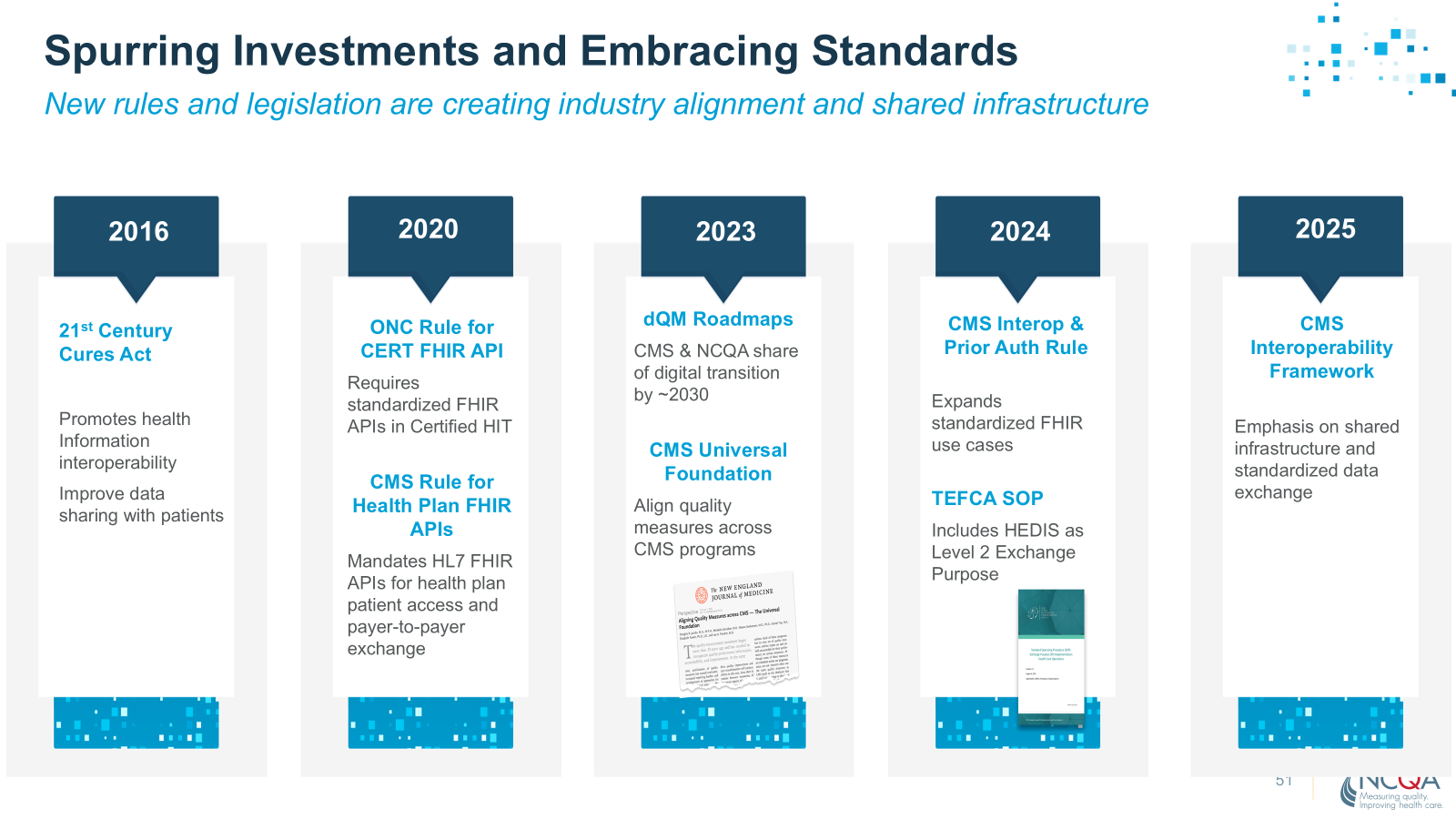
Over the past decade, national interoperability efforts have laid the technical and regulatory foundation for real-time, standards-based data exchange. The 21st Century Cures Act of 2016 established a clear federal mandate to improve interoperability and prevent information blocking. Continued efforts by the Centers for Medicare & Medicaid Services (CMS) and the Office of the National Coordinator for Health Information Technology (ONC) have reinforced the expectation for greater data exchange.
Adoption of standards such as FHIR and Clinical Quality Language (CQL) has accelerated, creating common technical frameworks that can support reuse and consistency. At the same time, many organizations continue to face real challenges accessing clinical data in standardized formats, navigating cost and operational complexity and determining how to use emerging data streams. Realizing the full promise of digital quality measurement will depend on opening up more interoperable data streams—work that is well underway but not yet complete.
Measurement Requires a More Sustainable Approach
At the same time, the administrative burden associated with traditional quality measurement has become increasingly difficult to sustain. Many current measurement processes were designed for a world in which data was fragmented, inaccessible and difficult to standardize. As a result, organizations rely on manual abstraction, spreadsheet-based workflows and repeated interpretation of narrative specifications, often rebuilding the same logic multiple times for different purposes.
The national movement toward interoperability has laid the groundwork for scalable, real-time quality measurement that is sustainable and aligned with modern healthcare delivery. Digital quality measures (dQMs) are the key to this transformation, representing a shift in architecture, not just process. When paired with standardized, interoperable data, they can be integrated into EHRs and clinical workflows to enable more timely insights closer to the point of care.
Accountability Now Spans the Entire Healthcare System
Perhaps most importantly, digital quality measurement is a fundamental shift in how healthcare understands and improves itself. As value-based care, alternative payment models and population-based accountability expand, quality measures now touch every part of the healthcare system.
Health plans, clinicians, care management teams, population health programs, technology partners and regulators all rely on quality signals to guide decisions, allocate resources and assess performance. Yet in many cases, those signals are derived from different interpretations of the same measures and applied to different data sets, at different points in time. This fragmentation makes it increasingly difficult to manage accountability across the system or to align incentives around shared goals.
A more standardized, interoperable approach to measurement is essential. Digital quality measurement makes it possible to apply the same measure logic across multiple use cases—reporting, analytics, care management and decision support—using shared data standards. Rather than translating health plan measures downstream into separate tools and workflows, digital measures allow quality to function as a common language across organizations, supporting consistency, trust and coordinated action.
Over time, this enables a learning health system where data flows seamlessly, measurement is embedded in clinical decision-making and insights are delivered in real time to those who need them most. This transformation empowers clinicians to act on quality signals at the point of care. It gives payers and policymakers the tools to align incentives with outcomes. And it ensures that patients benefit from a system that continuously learns and adapts.
A Convergence Moment
Taken together, these forces mark a turning point. The policy foundation is in place. Interoperable data exchange is increasingly the norm. The limitations and costs of traditional measurement approaches are widely recognized. And accountability for quality extends across the entire healthcare ecosystem.
Digital quality measurement sits at the intersection of these trends. It offers a path to reduce burden, improve timeliness and standardize measurement in a way that aligns with how care is delivered and managed today. Realizing this potential will require sustained effort: Investment in data infrastructure, alignment across stakeholders and a shift in how organizations operationalize quality. But the question is no longer whether the system should move in this direction, but how quickly implementation can catch up with opportunity.
What Are Digital Quality Measures?
To understand dQMs, it’s important to first define quality measures more broadly. Quality measures are tools used to evaluate how well healthcare services are delivered. They assess aspects such as patient outcomes, safety, timeliness, effectiveness of interventions and patient-centeredness. Traditionally, HEDIS® and other quality measures have been published as narrative specifications that each organization must interpret and program on its own, and they are populated using a mix of claims, manual chart review and supplemental data, often producing insights well after care has been delivered.
dQMs represent the next generation of this work. The defining change is in how the measure itself is expressed: rather than a narrative specification, a dQM expresses the same measure logic in a standardized, machine-readable format—using standards like FHIR and CQL—so that it can be interpreted and executed consistently across systems. This shift enables a level of automation, scalability and consistency that narrative, manually programmed specifications cannot match on their own.
It helps to separate three distinct pieces that are often discussed together:
The data.
The clinical and administrative information a measure runs on, and how readily it can be accessed in standardized, interoperable formats.
The measure logic.
The computable expression of the measure itself (the dQM), written once in FHIR and CQL rather than reinterpreted by each organization.
The use case.
What organizations do with the results, from retrospective reporting to care management, population health and decision support.
A dQM is specifically the second piece, the measure logic. The efficiencies people associate with digital quality—less manual chart review, more timely insight—are unlocked when computable measure logic is paired with interoperable, readily available clinical data. The dQM standardizes the logic; the availability of standardized data is what reduces manual abstraction over time.
CMS defines dQMs as quality measures that use standardized, digital data from one or more sources of health information that are captured and exchanged via interoperable systems; apply quality measure specifications that are standards-based and use code packages; and are computable in an integrated environment. (Source: ecqi.healthit.gov/dqm/about-dqms)
CMS further explains that the set of solutions supporting dQMs enables organizations to query data from standards-based application programming interfaces (APIs), such as FHIR APIs; calculate measure scores; and generate outputs necessary for quality reporting, while also supporting quality improvement efforts.
This definition is important because it clarifies what makes a measure truly “digital.” Simply running a measure using technology does not, on its own, make it a dQM. Many measures today are executed digitally using proprietary data models and custom logic built from narrative specifications. While these approaches may automate parts of the process, they still rely on manual interpretation, organization-specific implementations and one-off integrations.
In contrast, CMS defines dQMs as those that are built on standardized digital data and standards-based, reusable measure logic. Rather than being derived from narrative specifications each time they are implemented, dQMs use computable code packages that can be executed consistently across systems and organizations. This distinction—between proprietary, custom-built implementations and standards-based, interoperable measures—is central to the digital quality transition.
dQMs are built to operate within modern, interoperable health IT environments and can draw on standardized digital data from a wide array of sources: EHRs, claims, registries, health information exchanges (HIEs), wearable devices, patient surveys and more. As this data becomes available in standardized formats, dQMs can measure more of what matters with greater accuracy and relevance.
The Architecture of a dQM
The architecture of a digital HEDIS measure combines a common data model (FHIR), computable logic (CQL) and deployable code packages. This structure reduces the need for manual interpretation of specifications over time, lowering programming burden and errors. It also supports more consistent measure calculation across organizations—an essential feature for benchmarking and accountability.
Building next-generation dQMs requires greater flexibility. Because HEDIS spans a wide range of clinical domains, care settings and data sources, NCQA has adopted a modular approach that leverages multiple interoperable standards. These include the U.S. Core Data for Interoperability (USCDI), QI Core (Quality Improvement Core) and HL7 FHIR. Together, these frameworks ensure that digital measures can be implemented consistently across diverse health IT environments while supporting a wide array of use cases—from retrospective reporting to real-time clinical decision support.
Digital quality measures are more than a technical upgrade—they signal a strategic shift in how quality is designed and used. By expressing measure logic in standardized, computable formats that can be integrated into clinical and operational systems, dQMs create the foundation for more timely insight, reduced measurement burden and continuous learning across the health system.
Tricia ElliottVice President of Quality Implementation, NCQA
This flexibility is essential for enabling health plans, vendors and care delivery organizations to tailor digital quality strategies to their unique infrastructures and goals. Whether embedding dQMs into clinical workflows or aligning them with value-based payment models, the ability to plug into a common ecosystem of standards ensures that digital quality measurement remains scalable.
Ultimately, dQMs represent more than a change in format. They reflect a shift in how measurement functions within the healthcare system—from a retrospective reporting exercise to a reusable, interoperable capability that can inform care delivery, care management and quality improvement in more timely and consistent ways.
Why Digital Quality Matters: The Value Proposition
dQMs create value across the entire healthcare ecosystem—wherever care is delivered or managed. Interoperability enables data exchange, but data alone is not enough. Shared standards, common data models and reusable, computable measure logic enable data to be used consistently across quality improvement, population health, care management, analytics and decision support. This allows organizations to move from fragmented, one-off measurement processes toward a more unified and efficient approach.
The industry is increasingly aligned around the need for and the benefits of digital quality measurement. The foundational elements of digital quality measurement are the same as other strategic transformation initiatives that are already underway, such as prior authorization reform. Organizations that act now to adopt dQMs will be better positioned to scale, adapt and compete as the healthcare system continues to evolve.
Enable real-time insight and actionable guidance.
Quality measurement began as a retrospective effort, but organizations quickly realized the need to identify gaps in care much earlier. As interoperable data becomes available, dQMs better enable real-time information that care teams and health plans can use to identify and close care gaps and improve performance under value-based care agreements.
Embed quality into workflows and decision-making.
dQMs make it easier to reuse standardized, computable measure logic across systems such as EHRs, population health platforms and analytics tools. This allows quality measurement to be more closely integrated into healthcare operations, rather than treated as a downstream reporting activity, reducing operational complexity and reliance on manual workarounds such as spreadsheets or disconnected reporting tools.
Standardize measure calculations across organizations.
HEDIS measures are defined through complex technical specifications that historically required interpretation and custom implementation by each organization responsible for programming the logic. dQMs provide a standardized, machine‑readable representation of that logic, reducing variation in interpretation and supporting more consistent implementation across systems and organizations.
Reduce burden and streamline measurement.
Traditional quality reporting relies on a combination of claims and encounters, supplemental data sources, and labor-intensive collection of clinical data from medical records. dQMs are designed to operate on standardized, interoperable clinical data—such as data exchanged using FHIR—when and where that data is available, including data aggregated through entities like health information exchanges (HIEs). Over time, as interoperable data sources mature and expand, this approach reduces reliance on manual abstraction, lowers the cost and effort associated with data collection, and supports a more scalable approach to quality measurement.
Enable reuse of clinical data and measure logic.
Interoperable clinical data creates opportunities for broader reuse across quality reporting and improvement activities. dQMs support this reuse by expressing measure logic in standardized, computable formats that can be applied across multiple use cases, helping organizations reduce duplication and improve the efficiency of quality measurement over time.
Support faster learning cycles and more proactive, data-driven care.
dQMs come with supporting evidence—the exact codes, dates and clinical events that led to inclusion or exclusion from the measure. This visibility strengthens trust in the reported results and enables care teams to act on the findings. Building quality improvement into the fabric of care allows organizations to assess the needs of their population more quickly and accurately and ultimately deliver better health outcomes.
Integrate within existing infrastructure in all types of organizations.
Standardization creates a more open ecosystem, reduces reliance on proprietary data models and makes it easier for organizations to integrate quality measures into existing infrastructure. Organizations can direct their technical resources to focus on innovation, rather than spending time and effort re-coding the measures each year. And health plans can explore different HEDIS reporting options with minimal disruption to their existing data model.
Enabling the Next Generation of Quality Measures
Aligning with shared data standards and interoperable formats does more than improve how existing measures are implemented—it lays the foundation for how measures can be designed in the future. Traditional quality measures were built for a more limited data environment, often focused on point-in-time events or discrete processes. As standardized clinical data becomes more consistently available across care settings, digital quality measurement enables more modular measure design, where components can be reused, combined and adapted across use cases.
This approach supports more longitudinal views of health, allowing future measures to better reflect condition progression and outcomes in context. This evolution builds on the strengths of existing measures, extending their intent and impact as the data and infrastructure needed to support newer, more advanced measurement approaches become available.
Digital quality measurement aligns with the future of healthcare delivery and the need for a standardized, longitudinal patient record for managing care. The digital measure logic can be repurposed for clinical decision making, care management and population health.
Strengthening Alignment Across the Healthcare Ecosystem
Every quality signal, data standard and reporting workflow ultimately exists for one reason: to improve care for patients. Yet today those signals are often derived from different interpretations of the same measures, applied to different data, at different points in time. That fragmentation is felt most acutely by the person at the center of care, who often experiences it as duplicated tests, missed follow-ups and gaps no single team can see. Digital quality measurement changes this. By making quality signals standardized, interoperable and reusable, it aligns payers, care delivery organizations, technology partners and government agencies to operate from shared, timely and trusted information. That coordinated effort across the system translates into better, more connected care for patients.
Here are some of the benefits of digital quality measurement, from each organization’s perspective:
Health Plans
Digital quality measurement enables teams across quality reporting, population health, care management and analytics to work from a shared data foundation and a more consistent view of performance. Today these functions are often supported by separate workflows, tools and data pipelines, which can lead to duplication, conflicting results and delayed insight. By applying standardized, computable measure logic to standardized data, digital measures make outputs more reusable across teams and systems.
As health plans invest in interoperable data capabilities, there is growing pressure for that infrastructure to deliver operational value beyond compliance. Digital quality measurement is one of the clearest pathways to that return. Over time—as data exchange matures—plans can increasingly use standardized outputs not just for reporting, but to support care gap closure, population health initiatives and member outreach. The result reaches members directly: less separation between “reporting” and “managing care,” and more timely action on the gaps that affect their health.
Care Delivery Organizations
For care delivery organizations, digital quality measurement improves confidence and predictability in how performance is measured and reported, an increasingly critical need as clinicians assume greater accountability under value-based and risk-based arrangements. It also makes it possible to leverage the same standardized measure content used for reporting to help manage care and populations.
Today, many organizations adapt measures from health plan specifications, use proxy measures, or rely on different data sources than their payer partners. This introduces variability, creates misalignment between reported and operational performance and makes contract expectations harder to meet. dQMs address this by applying standardized measure logic consistently across populations and settings, while still allowing appropriate adjustment for different use cases. And as interoperable data exchange improves, payers and care delivery organizations working from shared standards are more likely to see the same insights—so clinicians spend less time reconciling conflicting numbers and more time acting on what a patient in front of them actually needs.
Technology Partners
For technology partners, dQMs enable greater automation, efficiency and scalability. Standardized, computable measures reduce the need for labor-intensive manual coding and one-off implementations, increasing the potential for interoperable data exchange and reusable integrations. Standardized outputs also make it easier to integrate patient-level results downstream into clinical, care management and analytics workflows. With less effort spent reconciling data inconsistencies or maintaining custom logic, technology partners can focus resources on innovation: developing advanced analytics, workflow tools and decision-support capabilities that help care teams close gaps and improve outcomes for the patients they serve.
Government and Public Sector
Government agencies play a critical role in advancing data standardization and shaping a unified framework for quality measurement. dQMs offer a scalable approach to measuring performance across large public programs, including Medicare and Medicaid, while reducing administrative burden and improving transparency. With interoperable and increasingly timely data, agencies can better identify where interventions are needed, target resources to underserved populations and track progress toward population health and equity goals, improving outcomes at scale for the patients and populations these programs are designed to serve.
States and federal agencies have a unique opportunity to shape the future of digital quality—not just through policy, but through the contracts and incentives they set. When they require interoperability and high-quality data as part of vendor agreements, they send a clear signal: modernization isn’t optional. The technology is here, and even small, under-resourced organizations are proving it’s possible. With the right expectations and support, vendors will rise to meet them.
Kristine ToppeVice President of State Affairs, NCQA
When every stakeholder works from the same trusted information, the person who benefits most is the patient. Interoperability and dQMs are not an end in themselves—they are the means to more consistent, connected and continuously improving care.
- Improves care coordination. Sharing clinical data across organizations in real-time gives care teams access to accurate, timely information at the point of care, so patients get a more consistent and coordinated experience.
- Reduces unnecessary care. When care teams can see which services were provided, patients are less likely to receive duplicative or unnecessary care.
- Earlier identification of care gaps. Patients receive accurate, timely reminders about the preventive services they need, helping reduce the risk of complications before they occur.
- Supports whole-person care. Care teams gain a more complete, longitudinal picture of a patient’s needs, allowing them to move beyond a siloed view toward more integrated care.
- Improves outcomes through timely action. With shared clinical data, patients are more likely to receive important tests, treatments and follow-up care, leading to earlier detection or interventions and better outcomes.
- Reduces frustration. Free flowing data reduces administrative paperwork and delays, making the care experience more seamless.
As the industry moves toward value-based care and continuous performance improvement, digital quality measurement offers a scalable, sustainable path forward—one where shared, trusted information helps every participant contribute to smarter operations, stronger accountability and better care for patients.
Aligning the Ecosystem: Fixing the Disconnect Across Teams and Tools
Digital quality measurement depends on a well-aligned ecosystem—one where each stakeholder plays a distinct but interconnected role. Success requires more than individual innovation; it demands shared infrastructure, common standards and coordinated governance. Public and private sectors must work together to establish a foundation that supports consistent, scalable and trustworthy implementation. When these elements come together, they form the backbone of a digital quality ecosystem—one capable of supporting more timely insight, reducing administrative burden and accelerating progress toward a more responsive, data-driven healthcare system.
Each participant plays a distinct role:
Federal and state agencies set the vision, create policy frameworks and offer incentives to modernize infrastructure.
Industry collaboratives define technical standards and provide implementation support.
Clinicians collect and document clinical data at the point of care.
Health plans aggregate data for quality reporting and align with regulatory mandates.
Technology vendors build tools that support data exchange and measure calculation.
NCQA serves as a content developer, validator and convener, digitizing HEDIS measures, defining data quality standards and leading working groups to accelerate adoption.
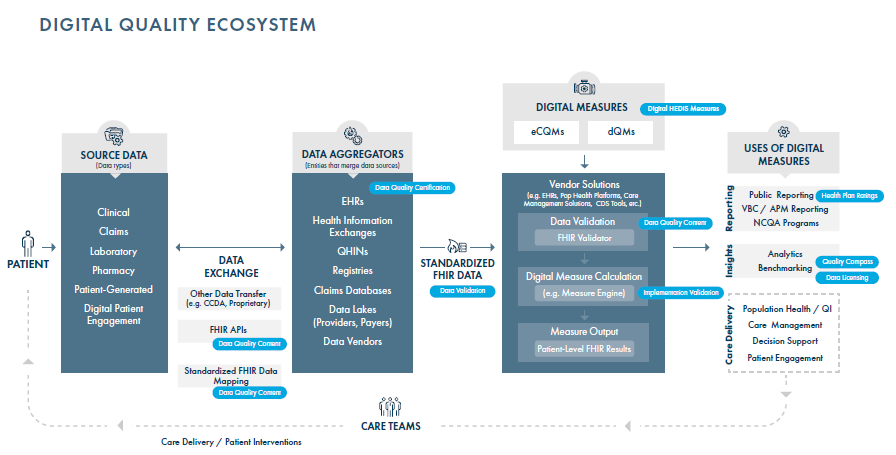
Beyond individual roles, success depends on a set of shared capabilities that hold the ecosystem together:
Common data models that enable consistent application of measure logic across platforms.
Reference tooling (such as CQL execution engines and test artifacts) that supports consistent implementation and verification of measure logic.
Certification pathways that build trust and transparency in how digital measures are implemented and used.
Community governance that aligns stakeholders around shared standards, implementation guidance and best practices.
When these shared capabilities are in place, digital quality measurement moves from concept to reality, enabling stakeholders to act on the same trusted information.
This alignment is already taking shape through national and industry-led collaboratives. Federal agencies like CMS and ONC are defining the vision and policy direction, offering incentives to modernize infrastructure and improve interoperability. Standards development organizations such as HL7 and implementation accelerators like the Da Vinci Project are defining the technical frameworks and publishing implementation guides that make scalable, real-time data exchange possible. Meanwhile, public-private partnerships like the Digital Quality Implementers Community are working to operationalize these standards by building shared, non-proprietary infrastructure and fostering collaboration across organizations.
Together, these efforts are transforming digital quality measurement from a compliance exercise into a strategic enabler of better care. By aligning teams, tools and data around a shared digital foundation, the ecosystem is moving toward a more responsive, equitable and learning health system.
Foundations: The Technology and Data Infrastructure Needed
Digital quality measurement does not require organizations to start from a blank slate or achieve full interoperability before taking action. Most healthcare organizations already have elements of the necessary foundation in place—such as EHRs, data warehouses, analytics platforms and reporting workflows—even if those systems were not originally designed to support digital measurement. The shift to digital quality is best understood as a journey: one that builds incrementally on existing capabilities rather than replacing them wholesale.
Organizations can begin this journey by leveraging the technology and data they have today, while planning for greater standardization, interoperability and reuse over time. Early efforts may focus on limited use cases, specific measures or partial data sources. As interoperable data exchange expands and standards-based approaches mature, those same investments can support broader, more integrated measurement across reporting, analytics, care management and performance improvement. In this way, digital quality measurement evolves alongside the organization’s overall data and technology strategy, rather than operating as a separate or parallel effort.
As organizations move forward, a set of foundational technology and data considerations can help guide progress. These are not prerequisites or one-time requirements but enabling capabilities that tend to mature over time. Understanding where an organization is today and how these capabilities can be strengthened incrementally, helps ensure that digital quality initiatives remain practical, scalable and sustainable.
Data Quality.
Without high-quality data, even the most advanced standards and systems fall short. Data quality is not a single attribute but a multidimensional one—clinical data that is fit for one purpose may not be reliable for another. For digital quality measurement, this means data must be complete, conformant, plausible, accurate and timely enough to support trusted results. Data quality also tends to improve incrementally, as organizations identify and resolve issues over time rather than achieving perfect data all at once. Traditionally, confidence in data has been established late in the process, through retrospective review. A more sustainable approach establishes trust earlier by identifying and addressing data issues closer to the source, before they affect reporting, analytics or care decisions. Strengthening the integrity of clinical data reduces downstream rework, unlocks more meaningful insights and builds the foundation that scalable, standards-based measurement depends on.
Shared Data Models.
Standards such as HL7 FHIR and CQL provide a common framework for structuring, exchanging and interpreting data. These standards support more timely interoperability and allow dQMs to be applied more consistently, regardless of the source system or data origin. By aligning with shared data models, organizations can reduce fragmentation across data silos and create a more cohesive ecosystem that supports continuous quality improvement and better outcomes.
System Readiness.
Standards alone are not sufficient; systems must be able to support them in practice. This includes EHRs, data warehouses and care platforms that can ingest FHIR resources, execute CQL logic and integrate digital measure outputs into workflows. Many organizations already have aspects of these capabilities embedded in their existing systems, even if they are not yet fully activated or aligned. As organizations plan, it is important to consider whether these capabilities can operate at the scale their populations and reporting demands require. Progress further depends on ensuring that IT teams, clinical leaders and quality improvement staff understand how dQMs fit into workflows and broader strategic priorities.
Vendor Alignment.
Technology partners play a critical role in supporting interoperable standards and capabilities that enable broader adoption across the healthcare ecosystem. When vendors build solutions compatible with standards such as FHIR, they help health plans and care delivery organizations scale digital quality measurement more efficiently, reduce implementation friction and apply measures more consistently across platforms. This alignment supports gradual enterprise-wide integration and unlocks greater long-term value from standards-based quality reporting.
Bidirectional Data Exchange.
Bidirectional data exchange transforms the way healthcare organizations collaborate by enabling information to flow to and from clinicians, payers and other stakeholders. This two-way communication creates a dynamic feedback loop that supports more informed, responsive and coordinated care. When clinicians receive timely insights, they can act on that information during the patient encounter, improving clinical decision-making and care outcomes. At the same time, clinicians contribute valuable clinical data back into the system, enriching the data available for quality measurement, population health management and payer reporting. For patients, bidirectional exchange means fewer duplicative procedures, better care coordination and a more seamless experience across settings. It supports longitudinal records that follow the patient, enabling continuity of care and more personalized treatment.
Organizations don’t need to wait for perfect conditions to begin. They can start with the systems and data they already have and build maturity over time.
By focusing on data quality, adopting shared models like FHIR and CQL, ensuring system readiness, aligning with vendors and enabling bidirectional data exchange, health plans and care delivery organizations can move from fragmented efforts to a unified, scalable approach. These foundational elements not only support real-time measurement and continuous improvement—they lay the groundwork for a future where digital quality measurement drives better care, stronger collaboration and tangible impact across the entire ecosystem.
HL7 and FIRELY’s 2026 State of FHIR report of respondents surveyed globally highlights a global shift toward interoperable, standards-based healthcare data exchange.
- Lack of FHIR knowledge
- High investment cost
- Unclear or inconsistent regulations
- Unclear benefits
Courtesy of Firely and HL7. Source: 2026 State of FHIR Survey Results
Implementing FHIR as a common data model in healthcare is one of the key pieces that enables the digital quality transition. We’re all agreeing to work from a common playbook. Even if it takes time, we know we’re heading in the same direction.
Foundations: The Culture and Collaboration Needed
In many organizations, quality measurement occurs after care is delivered, with reporting processes and improvement efforts operating alongside each other rather than as part of a shared system. Quality reporting, care management, population health, analytics and clinical operations often rely on different data sources, workflows and timelines. Even when these teams share common goals, disconnected processes can create inefficiencies and limit opportunities for coordinated action. This is not a reflection of a lack of commitment to quality, but rather a consequence of how quality measurement has traditionally been designed and implemented.
Digital quality measurement creates an opportunity to redefine how quality functions across the enterprise. By combining standards-based data with reusable, computable content, dQMs become more consistently integrated into workflows and shared across teams. The resulting culture shift is less about redefining the purpose of quality measurement and more about enabling better coordination, clearer signals for improvement and more effective collaboration.
| Measurement In Legacy Operating Model | Measurement in Digital Operating Model |
|---|---|
| Risk-managed | Improvement-oriented |
| Controlled | Collaborative |
| Functionally siloed | Integrated |
| Rigid | Adaptable |
| Optimized for consistency | Optimized for learning |
Stability has long been a defining characteristic of traditional quality measurement programs. Quality improvement teams have built systems and processes that they understand and can repeat from one year to the next—even if those processes are cumbersome and substantively flawed. Any changes to the quality reporting process are perceived as risky.
Organizations are appropriately cautious when quality results are tied to financial performance. Successful transitions acknowledge and manage risk through validation, governance and incremental adoption. Organizations can overcome inertia and successfully navigate the transition thoughtfully and deliberately. The tools and technology are available, what’s needed is an organizational commitment to making the change.
Making the Digital Quality Culture Shift
Digital quality measurement provides a unified platform, but the organizational culture determines how well it’s used.
Collaboration.
Success requires collaboration across departments: quality, information technology, clinical operations, care management and population health. Teams need to work together to develop a plan for the transition, identify possible roadblocks and communicate the changes throughout the organization.
Shared ownership.
As dQMs are embedded within clinical and operational workflows, it creates a shared responsibility to review and act on the data to move the needle on quality measures. Quality improvement teams, which in many organizations have been the champions of HEDIS reporting, may need to adjust their processes and communications channels to incorporate feedback. Similarly, other departments may need to engage in quality measurement and reporting in new ways. Ultimately, quality becomes an enterprise-wide initiative that is more efficient and less costly than a siloed approach.
System-wide improvement.
Integrating clinical data into multiple systems and processes supports a culture of improvement. Teams using the data for decision support, risk scoring and other analytics needs can help identify and resolve data quality issues—and that effort will cascade throughout the organization. Data quality will continue to improve, boosting the accuracy of HEDIS reporting and ultimately leading to higher revenue and reduced costs.
We’re talking about an investment in infrastructure that will lead to better outcomes, more timely patient care and increased operational efficiency. And yet, many organizations have this sense of inertia. They know it’s coming, but there’s a lot of denial. Organizations that can break through that inertia have an opportunity to dramatically reduce their costs and become more nimble.
Marc Overhage, MD, PhDThe Overhage Group; Member, NCQA Board of Directors
Making the Shift: From Point A to Point B
Adopting digital quality measurement is not an all-or-nothing decision. Organizations can continue to meet today’s reporting requirements while building digital capabilities in parallel. As standards-based data becomes more accessible and systems become more aligned, digital quality measurement can play a larger role across reporting, care management, analytics and performance improvement.
By approaching the transition deliberately—starting small, validating results and expanding based on readiness—organizations can manage risk, build confidence and position themselves to take advantage of digital quality measurement as the healthcare ecosystem continues to evolve.
How to Get Started
While the transition will look different depending on the type of organization, below are some core recommendations to help organizations move from traditional HEDIS reporting to a digital quality operating model.
Organizations can successfully make the transition to digital quality measurement—regardless of their size or level of sophistication—if they set realistic expectations. This is a stepwise journey, with incremental progress. Early efforts allow organizations to build understanding, validate results and reduce uncertainty before scaling.
Although some industry trailblazers are far along the path, it takes a critical mass to achieve lasting change. As more organizations invest in technology and infrastructure to support interoperability and digital quality measurement, the vision of a more connected, data-driven healthcare system that delivers better outcomes for all patients comes increasingly within reach.
Digital quality measurement isn’t an all-at-once transformation. Organizations can start with a small set of measures, limited data, or a defined population, learn from that experience and expand as confidence grows. The goal is to build trust in the data and the results first, then scale deliberately over time.
Ed YurcisinChief Technology Officer, NCQA
Call to Action: What Healthcare Leaders Should Do Next
Digital quality measurement represents a meaningful shift in how quality is implemented, used and scaled across the healthcare system. The foundation is in place, supported by policy, standards and growing adoption of interoperable data. What happens next will be shaped by how deliberately healthcare leaders prepare their organizations for what lies ahead.
For health plans, care delivery organizations and technology partners, digital quality measurement is becoming an operational reality. Organizations with varying levels of quality measurement experience have already demonstrated that dQMs can be implemented successfully, often beginning with focused use cases and expanding over time. These early adopters have shown that progress is possible through focused planning, strong governance and a willingness to learn.
Despite the push to transition to digital quality measurement, most health plans do not have a strategy in place to support this change. The foundational elements needed for digital quality measurement are the same as other strategic transformation initiatives, such as prior authorization reform. The key is to harness existing technology investments and leverage them for digital quality measurement.
Digital quality measurement is more than just digital HEDIS measures. It requires an ecosystem of clinical data standardization and exchange. The capabilities and the infrastructure are rapidly evolving, creating a critical inflection point that allows us to move forward as an industry.
Actions Healthcare Leaders Can Take Today
The path forward will vary across organizations, but several actions can help establish a strong foundation for the transition:
There is a general consensus among industry leaders that interoperability is the path forward and early implementers have shown us that it is possible. The mandate is coming. Eventually organizations will have to do this. Now is the time to get started.
As you begin to plan the transition, start with these key questions to assess current capabilities, identify gaps and prioritize your efforts.
- Teams. Which functions need to be involved in the transition? How are those functions going to be impacted? What roles are needed to implement dQMs and what roles are needed to leverage the data going forward?
- Tools. What existing software and tools will be impacted by the transition? What new tools are needed? How can dQM logic be incorporated to deliver insights for better care delivery or population health management?
- Data. Who are the critical suppliers of data? What data are already in the FHIR format? Are standard codes being used consistently, or does the data need to be mapped before it can be used for dQMs?
- Workflows. Which business processes need to change? How can the teams redesign their workflows to be more efficient and leverage clinical data and digital measure logic? How are external customers impacted by the changes in workflows?
- Disconnects. What gaps exist between the current state and the future state? What resources, tools and data are needed to close those gaps?
NCQA’s Role: Enabling the Shift to Digital Quality
NCQA envisions a future where standardized, computable measure logic and interoperable clinical data enable quality measurement to function as a reusable capability across reporting, care management, quality improvement and decision support, creating a more connected healthcare system.
NCQA has long served as a steward of quality measurement and a trusted convener across the healthcare ecosystem. As the industry transitions toward digital quality, NCQA’s role remains the same: helping ensure that quality measurement is trustworthy, consistent and meaningful.
NCQA’s engagement in digital quality is not new. In 2017, NCQA and HL7 convened the first Digital Quality Summit, bringing together stakeholders across the ecosystem to explore how interoperable data standards could support the future of quality measurement. That early convening reflected a recognition that digital quality measurement would require coordination, shared standards and collaboration across organizations and sectors.
The industry has come a long way, but there’s much more work to do. NCQA plays a central role in building the foundation for digital quality measurement across multiple domains.
Measure and Content Developer.
NCQA develops and maintains the dQM content and the supporting resources that make standards-based measurement possible. This includes refining logic, value sets and specifications based on real-world implementation feedback; and strengthening the CQL, FHIR profiles and implementation guides that support consistent digital quality measurement.
Trust in Data and Measurement.
Trust is foundational to digital quality measurement. NCQA is evolving its data validation programs to support more automated, standards-based approaches to assessing data quality. This includes developing data quality specifications that can be embedded directly into technology to help determine whether data is “fit for use” for HEDIS. These tools are intended to reduce the burden of manual primary source verification over time, while maintaining the rigor and credibility that NCQA’s data validation programs are known for.
Tailored Support Across Maturity Levels.
NCQA recognizes that there is no one-size-fits-all path to digital quality measurement. Organizations vary widely in readiness, technical capability and use cases. To support this range, NCQA is expanding offerings and resources tailored to different stages of adoption, from early exploration to implementation at scale. NCQA will continue to expand support for organizations as they progress along the digital quality journey.
Convener and Community Builder.
NCQA has long served as a neutral convener across the quality ecosystem. NCQA continues to engage health plans, care delivery organizations, technology vendors and policymakers to share lessons learned, surface implementation challenges and inform the ongoing evolution of digital quality measurement.
Ecosystem Enabler.
NCQA’s role is not to deliver technology solutions, but to enable the ecosystem to do so. As part of this effort, NCQA is building partner programs and other ways to help organizations identify trusted collaborators. While the industry will innovate and deliver technology in many different ways, NCQA’s role is to ensure that the underlying digital HEDIS content and standards are consistent, reliable and ready to be used wherever those solutions take shape.
Standards Advocate.
NCQA supports interoperability by aligning measures with national standards and reducing implementation friction. NCQA staff contribute directly to the development of FHIR, CQL and data standards that underpin the nation’s transition to digital quality measurement by participating in standards communities, including HL7 and the CARIN Alliance for Blue Button.
NCQA is committed to supporting the industry in using digital quality measurement as a foundation for more consistent, scalable and meaningful improvement in care.
Visit NCQA’s Digital Quality Hub
Visit NCQA’s Digital Quality Hub to learn more about the transition to digital quality measurement. Contact us with questions or to find out how NCQA can help.
Explore the Digital Quality HubGlossary
- 21st Century Cures Act
- U.S. legislation enacted in 2016 that established national requirements to improve healthcare interoperability and prevent information blocking.
- Bidirectional Data Exchange
- The two-way flow of health data between organizations and systems, enabling both the submission of clinical data and the return of insights or guidance to support care delivery and quality improvement.
- Care Gap
- A missed or incomplete recommended clinical action, such as a screening, test or follow up, identified through quality measurement.
- Care Gap Closure
- Actions taken by clinicians, care teams or health plans to address identified care gaps and improve performance on quality measures.
- CARIN Blue Button®
- An industry initiative focused on advancing consumer access to health data through standardized APIs and interoperability frameworks.
- Clinical Quality Language (CQL)
- A standardized, human readable language developed by HL7® for expressing clinical quality measure logic and decision support rules in a computable format.
- Computable Logic
- Quality measure logic expressed in machine readable code that can be executed directly by software without manual interpretation of narrative specifications.
- Digital Quality Measures (dQMs)
- Standards-based quality measures that use interoperable digital health data and computable specifications to enable automated, consistent calculation across systems and use cases.
- Electronic Health Record (EHR)
- A longitudinal, electronic record of a patient’s health information that can be shared across healthcare settings to support care delivery and coordination.
- Fast Healthcare Interoperability Resources (FHIR)
- An HL7 standard for structuring and exchanging healthcare data using standardized resources and APIs, enabling interoperability across systems and platforms.
- Fit-for-Use Data
- Data that meets defined standards for accuracy, completeness, timeliness and consistency for a specific purpose, such as quality measurement or care management.
- Gravity Project
- A national collaborative focused on developing standards to represent social determinants of health data in interoperable formats.
- Health Information Exchange (HIE)
- An organization or system that facilitates the electronic sharing of health information across different healthcare entities.
- Health Level Seven International (HL7)
- An international standards development organization that creates and maintains standards for the exchange, integration and use of electronic health information.
- Healthcare Effectiveness Data and Information Set (HEDIS)
- A widely used set of standardized performance measures developed by NCQA to assess health plan and provider performance across multiple domains of care.
- Implementation Guide (IG)
- A technical document that specifies how standards such as FHIR and CQL should be used together to support consistent implementation for a specific use case.
- Implementation Validation
- A structured process to confirm that a digital quality measure is implemented correctly and produces reliable, consistent results when executed on standardized data.
- Measure Certification
- A formal process that evaluates whether a digital quality measure implementation conforms to specifications and produces valid, trustworthy results.
- Comparative Testing
- A validation approach in which digital quality measures and traditional measures are run to compare results and build confidence before operational or reporting use.
- Primary Source Verification (PSV)
- The process of validating reported clinical data against original source documentation to confirm accuracy and completeness.
- Qualified Health Information Network (QHIN)
- A network designated under TEFCA™ to support nationwide health information exchange using common technical and legal frameworks.
- Quality Improvement Core (QI Core)
- A set of FHIR profiles designed specifically to support quality measurement and quality improvement use cases.
- Trusted Exchange Framework and Common Agreement™ (TEFCA™)
- A national framework developed by the U.S. Department of Health and Human Services to enable secure, standardized health information exchange across networks.
- U.S. Core Data for Interoperability (USCDI)
- A standardized set of health data classes and elements required for nationwide interoperable health information exchange in the United States.
