
The Strategic Value of Delegation for Health Plans and Delegated Entities
December 9, 2025 · Guest Contributor
 Tsveta Polhemus, Assistant Vice President, Product Management, NCQA
Delegation enables health plans to leverage specialized expertise among trusted partners, strengthening oversight and advancing the quality and efficiency of care delivery. When implemented effectively, delegation promotes accuracy and operational efficiency, reduces administrative burden and creates opportunities for continuous process improvement. By aligning responsibilities with organizations best equipped to manage them, health plans can foster collaboration that supports better outcomes for members and a more sustainable health care system.
Delegation is about trust. A health plan trusts an organization to take care of its members according to a defined set of expectations. The delegate is a proxy for the health plan, because members put their trust in the health plan and expect the same level of service and attention from the delegate.
Utilization management, credentialing, population health and case management are the most commonly delegated functions. Some plans delegate network adequacy; a few delegate quality improvement.
There is inherent risk in delegation, including operational, regulatory and financial risk. When a health plan delegates a function, it retains responsibility and accountability to ensure that the delegate meets expectations. NCQA’s Health Plan Accreditation standards provide delegation oversight guidance to help plans manage risk.
Choosing a Delegate
Alignment between a health plan and its delegate can result in a positive outcome. Consider these key criteria when evaluating potential delegates.
- Delegation requirements. Are you allowed to delegate this function? Some functions, such as a population health strategy, may not be delegated. Check the NCQA delegation standards to be sure.
- Prior experience. How long has the delegate been performing the function? Can it provide references? View NCQA’s online report card for a list of NCQA-Accredited delegates.
- Policies and procedures. Does the delegate have written policies and procedures? Ask to review the delegate’s policies for information about how it handles complaints, and other operational processes.
- Systems. What systems will the delegate use to administer delegated services, and how will data flow between systems? Ask for a demonstration of the delegate’s systems and data reports.
- Staffing. Is the delegate’s staffing up to the task? Find out if the delegate plans to subcontract any services.
Performing due diligence includes auditing your internal systems to understand how the new delegate fits into your operations.
Benefits of Working With NCQA-Accredited Delegates
Delegation is a two-way street—a collaboration that, ideally, results in a quality outcome. Although NCQA does not require organizations to work with an NCQA-Accredited delegate, there are benefits.
Benefits to the Health Plan
Oversight relief. A plan doesn’t have to oversee its delegate for certain activities.
Automatic credit. A plan receives full credit (100% scoring) for eligible elements. Review the Health Plan Accreditation Delegation and Automatic Credit appendix for a list of automatic credit opportunities across programs.
Increased efficiency. Because they specialize in a specific function, delegates often perform that function more efficiently than trying to build it in-house.
Benefits for the Delegated Entity
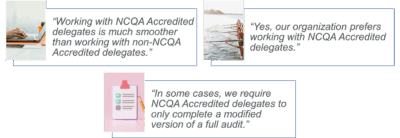 Better alignment. Accreditation helps you develop policies, procedures and processes that align with your customers.
Reduced burden. Accredited delegates have reduced audit oversight and faster delegation reviews.
Preferred partner. Accreditation makes your organization a more attractive contracting partner for health plans.
NCQA offers Accreditation and Certification programs for a variety of functions: Behavioral Health, Credentialing, Case Management, Population Health, Long-Term Services and Supports, Utilization Management, Wellness and Health Promotion.
Use our report cards to find NCQA-Accredited delegates and review their Accreditation status and any corrective action plans. But no matter which delegate you choose, the member experience is the top priority!
Learn More
Take our self-paced education course, NCQA Delegation Effectiveness Series.
Watch for our updated delegation toolkits—coming in early 2026!