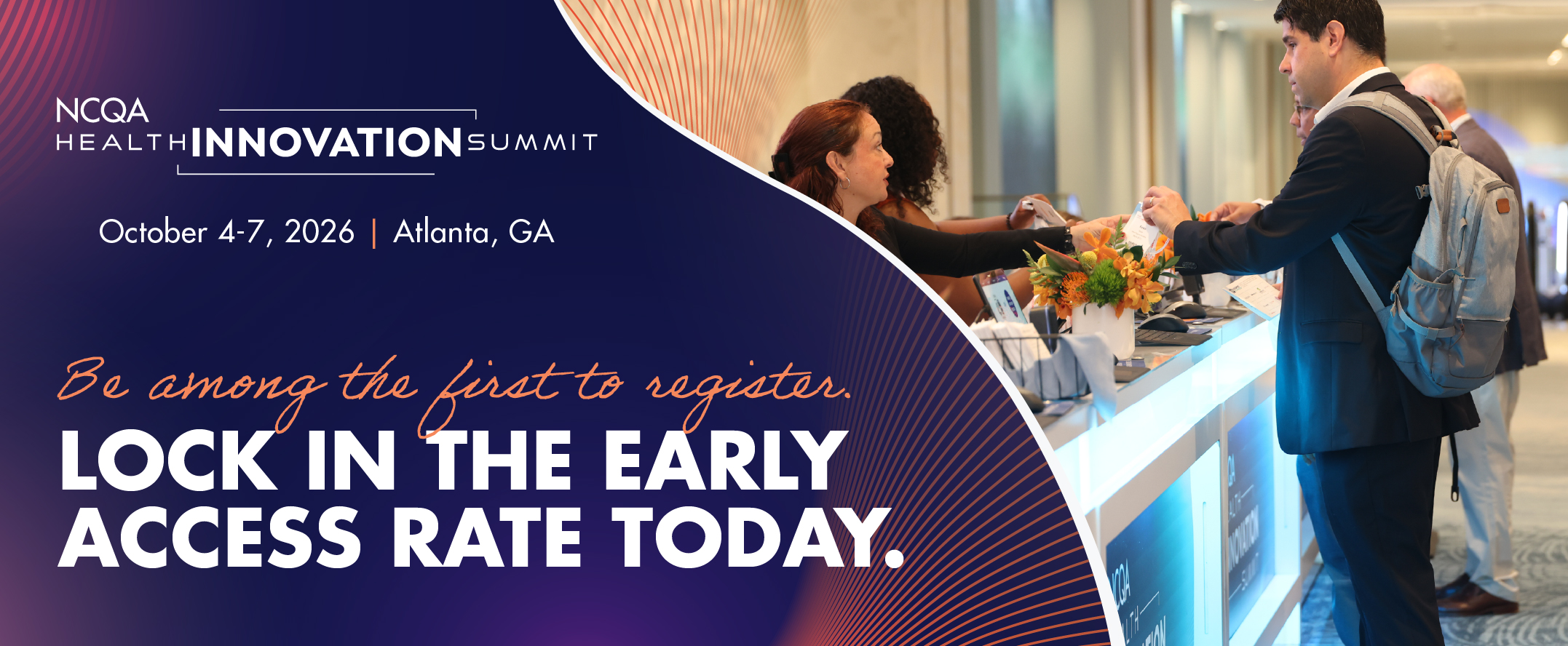
Hello, and welcome. We're going to wait a few minutes for a few more attendees to join us, so just hold tight for now. Welcome to everyone who's joining us today. We're just going to wait a few more minutes for some more folks to join, so just hold tight for now. Welcome to everyone who's joining. It looks like we have a critical mass here, so let's get started. Welcome, and good afternoon or good morning depending on where you are. This webinar will provide an overview of a few topics that NCQA has open for public comment until April seventeenth, including a proposed new program, wellness and condition management, which is intended as a modernized version of an existing NCQA program called accreditation and certifications in wellness and health promotion. And this public comment period also includes proposed updates for twenty twenty seven evaluations in patient centered medical home recognition or PCMH recognition, focusing on updates to criteria in the care management and support or Centimeters concept. Public comment for both of these topics is open to anyone whether or not they are a participant or a potential participant in that program. So we encourage everyone on this call today to consider submitting comments for both of those topics to ensure that NCQA, you know, has multiple perspectives to draw from when it makes its final decisions. And our goal today is going to be to provide an overview of each program and its proposed updates so that you can effectively participate in public comment on one or both of these topics. We don't intend today to collect live public comment feedback during this webinar, but there will be some time at the end of today's webinar for q and a. And it's also not our intent today to ask any you know, or answer any granular questions about the intent of the updates or dig into the details of any particular changes during this webinar, but we will show you at the beginning where to find the prepared materials that may answer some of those questions if you have them. And if you still have questions like that that are granular about the intent or the the details of any particular update, after reviewing the materials that I'll show you how to find and access. We also encourage you to submit a PCS case through my dot NCQA. So if you do have questions about public comment, the process, or other questions outside of what I just described that we won't be covering today, please feel welcome to send those questions using the q and a function at the bottom of your screen during any time during today's today presentation. You also have an option to submit that question anonymously if that's a concern for you. And before we get too much further, I will introduce myself. I am Elizabeth Ryder. I'm an assistant director in NCQA's product management team. And today, I'll be joined by Jenny Susie, who is a senior manager in NCQA's product management team. She will provide an overview of the public comment proposals for wellness and condition management, and also by Jess Tomko, who is a manager in NCQA's evaluation programs policy team. She's going to provide an overview of the patient centered medical home recognition updates. And before I do hand it over to Jenny, before you know, for those of you that are familiar with NCQA's public comment process and have participated in the past, You will notice that NCQA has recently introduced a new public comment experience. So I want to spend a few minutes providing a quick overview of that end to end process and give you an opportunity to ask any questions about that that we can answer at the end of today's webinar as well. So I'm gonna show you. If you are ever looking for an NCQA public comment, you may have received a link to that. We can drop a link to this public comment web page in the chat for today's webinar. But if you were looking for NCQA's public comments, just online on Google search, for example, NCQA has a landing page for public comments, and it will show any that are active. So if you wanted to access it that way via, just a Google search or via NCQA's website, you can navigate here. We drop the link in the chat. And then if you click on that link, it will show you, the details about the public comment. So this is where we provide a summary of each public comment and a breakdown of that topic. It is also where for each topic, you will find some reading materials that seek to answer some of the questions that I said we wouldn't cover today. We always include an overview memo that gets into things more like the intent, what our thinking was, where we got recommendations, and how we vetted them. It will usually have this a separate stand alone document for the standards themselves, whether it is the proposed new program standards for wellness and condition management or proposed updates showing changes that are proposed for a patient centered medical home. And then there is a stand alone list of questions that are meant to be more portable. This is what you will see in the public comment system when you navigate to NCQA's website. But you could also take this, you know, internally to facilitate conversations and collate and coalesce on your responses before submitting it in our system. Now for the wellness and condition management proposed program, there are two additional documents that you want to look at. There is a proposed measure. So there is a separate document for the proposed measure specifications and a separate template having to do with that proposed measure. And if you are navigating to submit public comments using this descriptive web page, with the overview of the topics and all the materials, if you wanted to go ahead and submit your comments, you would click this bottom button, sign in to comment, and it will take you directly to a screen where you, in your my dot NCQA account, can submit those comments. But you could also access that same place through your my dot NCQA homepage. If you scroll down in your homepage, whenever there is an active public comment, there will be a new tile on your homepage that does not normally exist. It is called public comments. And so if you click the button there, it will take you to the same place that the link on the web page with the red button would take you, which is here. And then to submit the, begin the actual public comment submission, You would click the blue button, add comment. And from this list, you would pick either topic and then click take survey. Something that I wanted to model because this is one of the main changes in the public comment process with this new experience that we've implemented starting last month, is it will take you something, to something that looks more like a survey than, the previous experience, which was more a series of drop downs. Both of these public comment topics and their related surveys have a few questions at the beginning that are required, and those questions are things that tell us how to understand your answer and what you are interested in answering. Those are the only required questions. From there, it will take you, depending on your response, to a screen, and I'll navigate there now, with a series of optional questions. And you'll see very different formats than what you're used to seeing from the past NCQA public comment experience. So some of those questions, for example, might look like a rating. Some of them have a free text response where you are free to type anything you want, multiple choice. Some things have to do with ranked choice, or you could select multiple, options from the response list. So this is the new public comment experience. If there are any questions about that, we you can revisit that at the end during the q and a. But I think at this time, I'm going to hand this over to Jenny to give us a presentation of the proposed changes for the wellness and condition management program. Hey. Good afternoon, everyone. Like Liz said, my name is Jenny Susi, and I'm really excited here to talk to you all about the wellness and condition management program. Hannah, if we go ahead to the next slide. So I want to provide a little bit of context. I know Liz mentioned that this is thought of as an evolution from our wellness and health promotion program, And how this all came to be was we were thinking about the quality problems and the quality problems that exist within this space when we think about vendors who are providing support to members so that they can self manage either their wellness or condition management between visits. And so, really, what we identified were two key quality problems. So first, there's this lack of trust. There's this lack of trust between vendors and the purchasers that they work with, vendors and patients, patients in the health system. And so really trying to understand, these vendors provide the services that we need? Do they actually work? Vendors are wondering, are health plans, are purchasers giving me all the data that they need that I need to be able to support their patients? And patients are wondering, is this going to work for me? And we think part of that problem is due to a lack of quality infrastructure. We know when we think about, the traditional within the walls of the health care system, health systems, health plans, the providers, there's this common language we use when we talk about quality. And we don't see that as much as a capability when we look at vendors, you know, typically due to size and scale. And so thinking about how can we help create a quality framework and infrastructure that will allow vendors and purchasers to really speak a similar language when we're talking about quality and the offerings of a program. And so that's really what led us to this updated version of the program. We go ahead to the next slide. And so when we look at this program and we look at, the updated version, you'll see some things that are similar from our wellness and health promotion program, including health risk assessments, but you'll also see some updates. So, like I said, this accreditation is primarily designed for vendors, and it's going to allow them to demonstrate their ability to assess, and empower members to manage their own health across the risk continuum. And so what that means is helping folks from maintaining their wellness and promoting health all the way through condition management. And so what that looks like is, a set of core standards that all organizations will need to complete. Talk a little bit more about what's included in those on the next slide. And then organizations will have the opportunity to complete a health risk assessment module and or a digitally enabled engagement module. And you can see the standards that are included in each of those here. And, again, we'll talk about those a little bit more in the next slide. And we think about what problem this is going to solve. This is really gonna help vendors identify themselves as high quality partners and ability to demonstrate value in terms of quality. It's gonna help purchasers, so health plans, providers, employers, decrease that administrative burden when identifying solutions, manage costs, and hopefully reach their patients more meaningfully. And for patients and care teams, this helps identify trustworthy, high quality programs to leverage. And overall, we see this as that language and that infrastructure that's going to help vendors and purchasers, increase trust and increase their ability to understand value propositions across the two. So if we go ahead to the next slide. Like I said, we're gonna talk a little bit more about what goes into each module. So our core content, this is these are standards that all organizations will be required to complete. You can see here the seven standards that are listed. These are some are from our existing wellness and health promotion standards, some leverage health plan accreditation, and others leverage our health outcomes accreditation, as well as some new content specific to this program. And so the goal of this is really to assess the foundational functions of an organization, making sure that they offer appropriate transparency, capability for data exchange and integration, privacy, confidentiality, rights and responsibilities, the ability to conduct an initial population assessment, and that the services provided are accessible and available in an appropriate way. So if we go ahead to the next slide. Then you'll see we have our health assessment module. This one does look fairly similar to what currently exists within WIP. You'll see here that there are three standards and the goal here is to assess the ability to conduct detailed health assessments and use that to inform health interventions. If we go ahead to the next slide. Next you'll see our digitally enabled engagement module. This is new and this module really reflects an updated iteration of our self management coaching and content, modules that previously existed and really modernizes them, recognizing that as content becomes increasingly engaging, the overlap between self management and health coaching, makes it more relevant to look at this as one complete package rather than two separate offerings. And so here you can see, again, what we're looking at is the ability to assess the capability to deliver interventions that promote healthy behaviors and reduce risk for eligible individuals. And what you'll see across all of these modules that we talked about is that measurement is a key theme within each. And so I want to talk a little bit about how specifically we are approaching measurement. Go ahead to the next slide. So we have two types of measures that will be included in this program. And you can see here to the right the three modules and the outlined types of measures that will be asked for within each. The first type of measure is an NCQA defined measure. So you will see those, in the health assessment module and the digitally enabled engagement module. These are metrics that will be defined by NCQA that the organizations will submit using a template. Organization defined, which you can see in the core standards and the digitally enabled engagement module, offer a little bit more flexibility recognizing that organizations are working with different sets of data and have different goals that allow their program to be successful. So organizations, will complete and submit their own pre their own self defined metrics using a template that NCQA developed to make sure that all measures are looking at an evidence base, have inclusion and exclusion criteria, and have a clear definition of success. If we go ahead to the next slide. And so one of the measures that we had on there was our, measurements of patient engagement. And so I want to talk a little bit about how we identified goal setting as the first way that we're going to look at patient engagement. And so really what we heard is that outcomes are incredibly important, but they're not always something that is clear to identify within the scope of a program that a vendor's providing. Engagement is really what's important. We wanna understand is this vendor solution able to activate members and patients to engage in their own health and lead in self management. And often or members aren't in these programs long enough to show long term outcomes. And so making sure that we're able to assess both those short and long term goals and outcomes are important to us. It might just be on my end, but I think we lost the slides for a second. Give me one second. Let me see if I can pull them up on my end. Good news is we were almost done. Give me one second. Was it the last slide, Jenny? I can bring it up. Yes, please. If you have it in front of you, that would be fantastic. Yep. When actually, Liz, I'm oh, there we go. Perfect. Thank you so much. So, like I was saying, goal setting, why are we selecting goal setting? What we've identified is that these programs, despite the differences they may come to the table with, they all have a shared theory of action. And so what that means is they're looking to identify and engage a population, change their behavior, and evaluate the outcome. What goal setting is going to allow us to do is to identify who is able to truly engage populations to change those behaviors. And so we see this as part of a larger set of measures that NCQA is exploring to really understand how do we measure what actually matters within these programs and understand what is actually providing that engagement that leads to behavior change. And so I would strongly encourage you all when you look at our public comment to tell us how this fits in with the way you approach members, with the way you would like the vendors you work with to approach members, and whether this is something that you agree is a fair representation of engaging a population and, meaningfully working towards those outcomes and behavior changes. And so with that, I am gonna hand it over to my colleague, Jess Tomko, to talk a little bit about PCMH and those updates. Thank you, Jenny. Can everyone hear me on mute? Okay. Zoom has a mind of its own today. So thank you, Jenny. Yes. As she mentioned, we will be going over, proposed updates for our next version of the PCMH recognition. So with that, we'll jump into a quick overview. Next slide, please. Alright. So just as a quick level set, as the section will be very straightforward, once we dive into the criteria. But for those of you who have not had a chance to take a look at the public comment material, we currently have a proposal to revise three core criteria specifically within the care management concept of the PCMH recognition and retire one elective criteria within the care management and support concept of PCMH. Next slide, please. Alright. So jumping into it, right away, we, are proposing a modification to CMO one, which is identifying patients for care management. That modification is essentially augmenting, the guidance to specify that pediatric specific practices must select at least two categories for care management within CMO one. So, for those existing customers, I'm sure you're all well aware that right now our criteria indicates that within TM o one, every practice must identify three categories that they are using to identify patients for care management. Through the feedback that we've received through internal and external customers, we have proposed the update to change or modify that threshold for pediatric specific practices. So what that would mean is if a pediatric practice historically care managed for, say, behavioral health conditions, social determinants of health, and poorly controlled or complex conditions, they would only need to, moving forward, submit two of those three categories, in future, recognition sustaining efforts. Next slide, please. Alright. So then, moving on to CMO two, which is the monitoring of patients for care management based off of those categories identified in CMO one. We, again, are looking to augment the, criteria to indicate that not only thirty patients must be identified for care management, the modification that we are proposing is an or one percent of your total patient population. So really, that comes into play for practice sites that have a patient population of three thousand patients or less. Those practice sites would be able to submit one percent of their patient population as patients that are identified for care management. Reason being is as our current customers are likely aware for those small satellite practices that we often see challenges in identifying that minimum threshold of thirty patients, they will be able to submit their practice site specific evidence in a right sized sample for, their sustaining efforts. Next slide, please. Alright. So, CMO four is two parts, which we are focusing on the person centered care plan. So the actual written care plan document and what that looks like. So first and foremost, we would like to or we are proposing a modification in updating the criterion to indicate that patients are engaged in care management, not just identified for. Reason being is oftentimes we receive questions, especially when organizations are finding a challenge of patients wanting to engage in care management. We're really focusing on the patients that you have identified and are actively participating in care management to have those care plans. So we don't want to unnecessarily, place an unnecessary burden on organizations if, yes, these patients have been identified. We cannot generate a care plan because they're not willing to participate. We completely understand that. So we'd like to update the guidance to say seventy five percent of patients who are engaged in that care management effort. And then the second part of c m o four, if we can go to the next slide, is a proposal in the updated requirements for what elements at a minimum should be included in the person centered care plan. So on your screen here, you have, the listing of the current requirements that our evaluators look for within the person centered care plan. And then on the right side, you have those proposed updates. So maintaining the comprehensive problem list, maintaining the medication list and management, and also the schedule to review and revise. The modifications really come in to play when we look at those expected clinical outcomes and or patient treatment goals. We want to modify that, and we're proposing that to be modified into a patient centered SMART goal that informs of the expected clinical outcome and or the patient treatment goal. Reason being is understanding that, in certain care plans, most often, care planning for SDOH, it's sometimes a bit of a challenge to identify those two individual, aspects depending again on the patient, the circumstance, and the care efforts. So, really, those patient centered SMART goals should inform of the expected clinical outcome or the patient treatment goal, but it's allowing, organizations to have a little more autonomy in what that looks like to tailor to that specific patient. Additionally, our proposal is to include the names and roles of care team members. So really just, with the intention of the care plan being that one stop shop for the patient, family, caregiver, being able to indicate the key players within the patient's care. So if there is a nurse care manager, if there is a primary care physician, perhaps the medical assistant for that physician is very active in coordination, you'd wanna list those key personnel, understanding the nuance of sometimes, especially within smaller practices, the PCP is the care manager. We would, of course, update the guidance to accept the listing of the PCP as that care team member. And then finally, and this ties into that last point in our overview, we are proposing the retirement of the elective criteria, which is the inclusion to barriers to care within the Centimeters concept and incorporating those requirements as a minimum requirement within the person centered care plan. So most often, we already see these conversations are happening, across our customer base based off of evidence that is submitted and also electives that are indicated when transforming. But, ultimately, barrier secure really address this potential, success or challenges of a current care plan. So we feel it is important to include that within the person centered care plan so that all parties, again, the patient family caregiver, maybe it's a specialist that is also involved in the care so that everybody who needs to be aware is made aware of any challenges or barriers so that ultimately we can find patient success in that. And I believe that wraps up our PCMH update. So I'm gonna actually kick it back over to Liz who's going to walk us through the feedback submission. Thanks so much, Jess. And this is just a a brief recap, since we went through pretty quickly with a live demo at the beginning of how to submit public comments. And after this, we'll get to the q and a section. I see a lot of great questions coming in through the chat, and we'll try to address any that we can. But just that recap of how to submit the public comments, we strongly encourage you, even though we're discussing some of these updates today, to go to the public comment web page and review all the materials there for each of these topics, just because the devil is in the details, and some of these questions are answered there. And from there, at the bottom of that web page or if you go straight to your my dot NCQA home account, you will be able to navigate either through the the tile on the home screen or that direct link from the public comment web page where all of the materials are. It will take you to a place to press the blue button, add a comment, and then be able to pick which topic you want from there and begin that survey, which has a variety of new formats and questions to ask you more nuanced questions than we have been able to in the past. And so with that, I'm gonna ask Jess and Jenny to join me on camera. I know that they there have been some questions trickling in, so I'm gonna jump in with a few that, you know, jumped out at me first. And then Jenny and Jess, I see some topic specific questions that I'm gonna ask you to try to answer. Or if it's something that we're not able to answer today or is really too granular, probably not likely to be a a frequently asked question for folks on this call, we might direct folks to PCS. So I know that there were a couple of questions around whether the slides would be shared after the presentation and whether the recording would be shared after the So I believe our intent is to share and upload a copy of the recording for the session after the webinar today, and we can also provide some of the links that we did live during the session in our follow-up to you all. But I don't believe that we intend to share the slides, so keep a lookout for the recording. I also have a question about why NCQA made their changes to the public comment process. This is something that we wanted to do for a long time based on feedback that we've been getting for a long time from all of you. And it's something that allows us to, as I said, ask more nuanced questions and get more nuanced answers from you all when we're making our decisions. So these are updates intended even though it's a a brand new experience, and that might have a little bit of a learning curve for some of you in doing it for the first time. We're hoping that this ultimately is a more seamless experience and an easier way for you to spend your time giving us valuable feedback. We would love, that being said, to hear from you, and there should be questions at the end of those topics to tell us how this experience went for you. So if there are any improvements that we can make from here with this new process, we hope that you'll tell us when you participate in public comment. Those are the two that jumped out at me. So I think the first topic specific question I see is for Jenny, and it's asking for you to be more specific about what you meant during your topic about vendors and specifically if you meant EHR vendors and their capabilities. Yes. So when we're talking about vendors in this situation, we are talking about organizations who are providing self management or coaching services for organizations or health risk assessment services for members to feel empowered to take control of their health, particularly between office visits. So this is more about being able to provide those self management tools and that health assessment service rather than having, EHR capability in this case. And I think there are a few other organization specific questions in the chat, and I'm happy to answer those via the chat rather than doing those out loud if that is helpful for folks. Alright. Jess, I see that there's one that you wanted to answer about whether there will be changes to twenty twenty six reporting for patient centered medical home recognition. Yes. And, I think we may have one or two of those. So, hopefully, my response will be all encompassing. So, ultimately, these changes, if approved through our EPC, go into our upcoming publication. That would go out to everyone, beginning July first of this year. The transforming publication of that release, would take effect January first of twenty twenty seven. So, ultimately, what that would mean is if you have enrolled in PCMH recognition recognition on January first twenty twenty seven or after, those changes would be applicable to your organization or, say, practice site that is newly transforming. That being said, we generally have a one year rollout, for the following year, for that to impact our sustaining practices as we want to ensure that our organizations, our recognized practices have enough time to operationalize updates. So that being said, that would likely go into effect for annual reporting twenty twenty eight as everybody who is currently in sustaining knows that you're reporting on work being completed within calendar year twenty twenty seven for the most part. So it's a little bit of a rolling answer, but please do not fret. These changes are not going to be in effect for, anybody who's already enrolled. You would be following the version that, was active upon your enrollment. Alright. Thank you, Jess. I think the next question you flagged for yourself was about c m o two, and I wanted to ask if it would be helpful if I went back to that slide. Potentially, yes. That would be great. Thank you. I really do appreciate that. And while Liz is navigating to that slide, I will, just go over the the q and a submission. But, ultimately, CMO two, Some current customers asked to share the CMO two patient population across two practice locations. That is what was referenced when we were talking about this, slide in organizations being combined or I'm sorry, practice sites being combined to report for care management, ultimately because these practices have a smaller patient populations. So with this update, the intention would be so that those organizations or I'm sorry, those practice sites no longer need to request to combine for care management reporting, but rather would present would submit one percent of their patient population so that it is, right sized for their patient population. So a patient panel, of, say, three thousand, of course, would be submitting thirty patients, or and if it was below three thousand, it would be adjusted based off of that one percent calculation. But, ultimately, with this update, the expectation would be that practice sites are submitting their site specific patient patients identified for care management because we are now having that one exception to tailor to your practice size. Alright. Thanks, Jess. And while we are here, there was a question about c m o one. So I can just go back one slide. Sure. And that question was if the the practice's patient population is both adults and pediatrics and multiple providers who are doing PCMH recognition, do they need to select two, or do they need to select three components based on this proposed change? Yep. Great question. And, actually, a question that we've, already received, so we will be, ensuring that this is included in the guidance. If your organization or your practice, let's say, is family practice, the expectation would be that you are submitting at least three categories for care management. Reason being is because a portion of your patient population does include that adult patient population. Really, this adjustment comes into play for very pediatric specific, pediatric only practice sites, as the expectation if you are treating adults within your panel as well. We're still requiring those three, categories. Of course, you can pick and choose which categories you're using for which populations. But as a whole, you would only be submitting three categories regardless of your split, between pediatric and adult medicine within your patient population, but you would be required to continue to submit three categories there. Thanks, Jess. And I think the next question is for Jenny. Do you wanna jump in? Yes. So we're seeing some questions in the chat from current customers who are curious about what that transition might look like. So I just wanted to highlight that we are actively working on a transition plan for current customers, and we strongly encourage you to reach out to your representative for a follow-up conversation about where the best fit might be for you. You should have also received an email about that today. When we're thinking about, suns the sunset of wellness and health promotion, the current certifications and accreditations that are, take place through twenty twenty seven, July twenty twenty seven, will be valid through their expiration, so those will not sunset early. And when we think about alignment across our current program, WIP and our new program, we see strong alignment for the self management coaching and health risk assessment modules. And so, again, I would strongly encourage you to reach out to your representative for a follow-up conversation. Thank you, Jenny. Jess, I have a few questions about c m o four here if you want me to jump in as well. Sure. I have a question about whether the care team members and, actually, I think we wanna go here, the names and roles of care team members. Whether that is describing internal care team members only, and, you know, are there any expectations for this requirement if they have external specialist care team members? Yep. So the expectation would be internal team members. We would not be expecting you to list out any or all of the team members, say, with the cardiologist that is partnering in your patient's care or what have you. So it would really be those care team members within your organization who are involved within the care plan. I also saw another question while I was skimming the q and a during Jenny's last response, and I just wanna reiterate. So especially, in those, small satellite practices that are maybe one provider, that one PCP may also be the care manager as well, and we understand that and recognize that. So as long as they are listed within the care plan, in the designation, you know, of primary care provider, we're not going to require that they're also designated as the care manager. But I would recommend once submitting probably adding that clarification so that your evaluator is aware of that. But that being said, we recognize that that is a factor as well. So that is something that we have every intention of seeing within some of our submissions. Jenny, I'm not sure if you answered this in your last one, but there's a a question here about which type of vendors you anticipate syncing, you know, to be recognized or accredited or certified, whatever that adjective will be in the new wellness and condition management program. Yeah. So I think I'll just reiterate there that these are consumer facing solutions that include apps and digital tools that are supporting members in self management either of their wellness or condition management. So that may be things such as diabetes, high blood pressure, cardiovascular disease, musculoskeletal behavioral health, and then general wellness. So thinking about nutrition, weight management, things like that would also be included. So it's really running a diverse spectrum, but recognizing that all of these programs are based on that same shared theory of action moving from, and I apologize. I'm hearing an echo of myself. I hope you all are on as well. But, being able to move through that shared theory of action from engaging members, to seeing that behavior change and then measuring outcomes, so within that scope. Alright. I have a few questions here about whether or not or how the recording of this webinar today will be accessed afterward. I think that it will be sent via email to everyone who registered for the event within a few business days. And I think it's likely too that it will be publicly available at some point. But, certainly, everyone registered here will get an email in a few business days with that recording. Alright. I do apologize. I see a lot of detailed and conditional and granular questions here that I'm gonna wait one more minute to see if there's more higher level questions about what we've covered and things that the team here anticipates there that participants wouldn't find in the materials that we've already prepared and that they'll have access to. And if not, if we haven't answered your questions, then I'm going to ask you to submit a PCS case in my dot NCQA. If you do not already have a my dot NCQA account, it's a free account. When you submit a question there, you get a response within a few business days directly from the policy and subject matter experts on those programs. So in all likelihood, if you have more questions about PCMH that we haven't answered today, it will be Jess or one of her teammates answering it then as well. So I do apologize for stealing you, Jess, for those more detailed questions. Jenny and Jess, I'm gonna ask, are there any more questions that you feel like you can answer live at this time versus steering folks to yes. Yep. I actually just ran across one. I think this is a general Centimeters inquiry, but, the question is if we have several providers, that we're working on PCMH recognition for, do we need to select care manage patients for each provider separately, or is the whole practice? So the intention is to utilize those three categories that are identified in CLML one to identify patients for care management throughout your entire practice or your individual practice sites. Theoretically, based off of general patient populations, it would not be surprising if, you have all of your providers represented within that patient population. That being said, I know that sometimes, especially in the primary care space, there are populations may differ from provider to provider. So if you have a concern, please, feel free to send a PCS case to us, and we're happy to review that on an individual basis with you. Jenny, any other questions that you're able to answer from the q and a at this time? Nothing further from me. I did respond to some of the more specific questions in the chat, rather than doing them out loud right now. Okay. I have one more, Liz. Sorry. Because I do think that this is timely. Asking for clarification regarding AR twenty six and what customers need to demonstrate. So all of the requirements for demonstration for AR twenty six are included in our AR twenty twenty six publication. We have the transformation, guidance right next to the annual reporting guidance for, ease of access. That being said, if there is a cadence listed, with that criteria, so at least twice annually, for Centimeters, the expectation is that, you are demonstrating that, for example, care plans are being reviewer reviewed or revised at least twice annually for your customers, and that is in effect, currently within the AR twenty twenty six, publication and should be demonstrated in your AR twenty twenty six, submission. I see one more question that I think we we can answer. It has to do with the slide that I'm showing right now. Someone asked if the grayed out requirements on the left are going to be replaced, by I think they meant on the the right hand side, the three things that are highlighted. Yes. So if you see on the right hand side would ultimately be the, future state of c m o four. So we would still be maintaining the comprehensive problem list, medication list and management, schedule to review and revise. The grayed out, elements of expected clinical outcome and patient treatment goals would ultimately morph into a patient centered SMART goal. So as mentioned, that goal should inform of the expected clinical outcome and or the patient treatment goal, whichever is the most applicable. If both are absolutely applicable, then please, by all means, include those within the SMART goal. In addition to that SMART goal, the also the addition of the names and roles of care team members and the addition of barriers to care within the minimum requirements for person centered care plans. And apologies, Jess. One more one more question on what you just explained. There is a longer comment that we appreciate someone leaving, and I think there's an underlying question about when we say patient centered SMART goal, is that a field in the EMR that we want to see that they have, like a SMART goal field to meet that requirement as proposed? So we are not prescriptive in how or where these are documented as long as they are included within the actual person centered care plan. So that printed document or that final document that is finalized and uploaded to the patient portal, The intention of the person centered care plan is that all of these elements are in one single document, so that the patient family caregiver can continue on with their care, take that to their specialist visit, take that to a rehab, or what have you, so that you're able to continue on with those relevant players in the patient's care. That being said, we are not prescriptive in how or where that is generated from within your EHR system. It could be free texted as long as it is within the actual care plan itself. Alright. Jess and Jenny, we appreciate you answering some questions. Again, if we did not get to your question today, we really hope that you will submit it through the PCS system. That has the benefit of being documented for you as you are thinking about these changes if they are implemented, how that will apply to your evaluation. There's one last thing that I wanted to cover with this audience while we have you. For those of you that have not attended NCQA's annual health innovation summit, it is an excellent event. And this year, we will be holding it in Atlanta, Georgia from October fourth to seventh, so it's a little bit earlier than it traditionally has been. Registration for that is going to begin on April first. So we encourage you all to save the date, and we look forward to seeing you all there. Alright. Thank you so much. We appreciate your time. And, again, we we hope that you will participate in public comment for at least one, if not both of these topics. When you look, there might be more questions than you think you can do in one sitting. Don't worry. All of those questions except the first few that tell us more about you and what you're interested in are optional. You do not have to submit an answer for every question, and I believe it does save your progress as you go. So thanks again, and we hope to hear from you soon.
View Transcript
Updates to PCMH Recognition and the New Wellness and Condition Management Program
Attendees joined this webinar to learn more about the proposed new program and PCMH program updates. During the call, subject matter experts walked through the programs included in the public comment period. The NCQA team also shared details about the new public comment experience, designed to make it easier to provide meaningful feedback. Participants who joined live also had the opportunity to ask questions.

NCQA

NCQA

NCQA