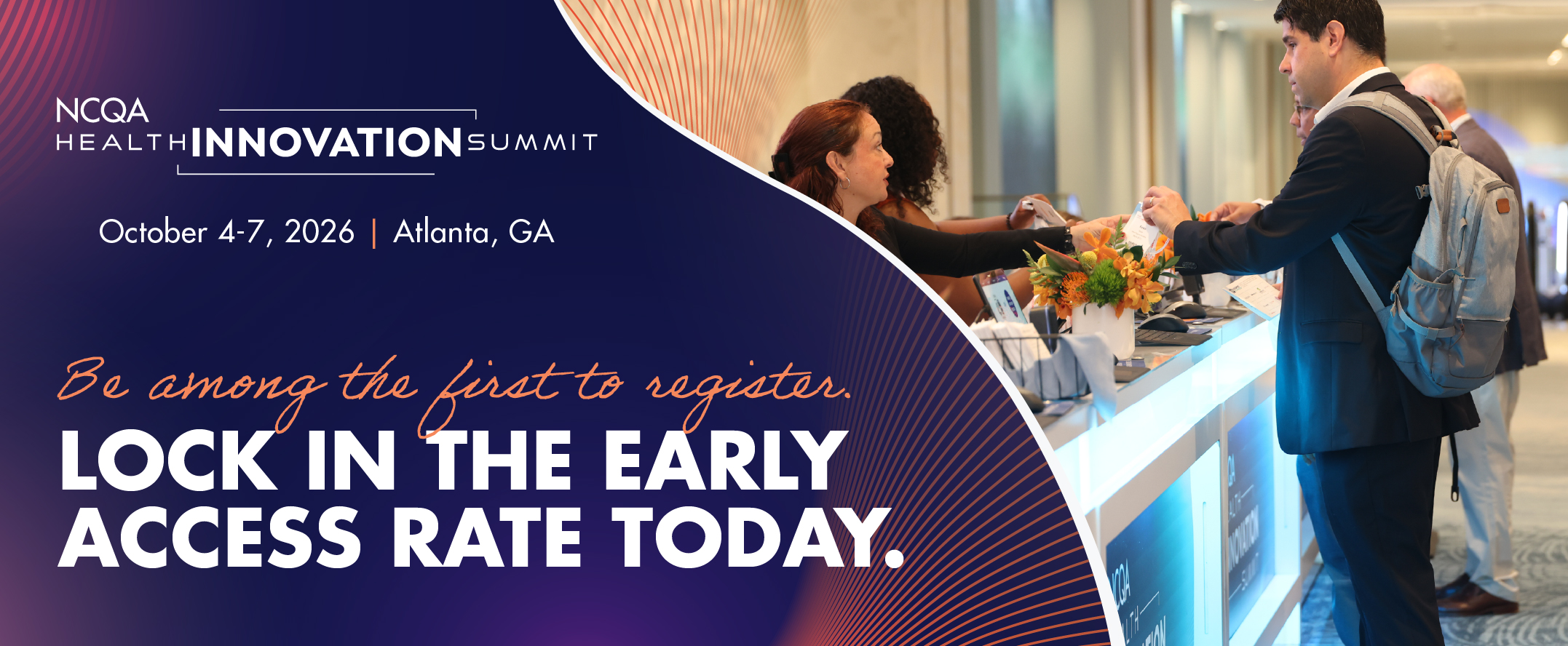

Thank you for joining today's webinar, Smarter Prior Authorization, Improving Outcomes Without Adding Burden. As many of you are entering this virtual meeting, I want to go through some logistics. So if we go to the next slide, I wanted to share with you that you can enter a question in the Q and A chat throughout the presentation. We'll reserve about ten minutes toward the end to answer as many questions as possible that you have raised. And if we do not get to your question, we'll try to do so via email. Also the recording, as well as the presentation slides will be shared with everyone who registered by the end of the week. So sometime on Friday. So thank you again for joining. I will kick us off with some formal introductions and welcome. I am Sveta Bohimes. I lead product management for evaluation programs at NCQA. I will start with a simple observation, and this is something that perhaps you and others have experienced. Behind every prior authorization is a patient waiting for care and a clinician trying to do the right thing. So when the process creates friction, the impact is real. But rest be assured, today's goal is to explore what better prior authorization can look like for patients and clinicians, and what it takes in the real world to reduce burden while supporting timely clinically appropriate decisions. To ground this discussion, I am thrilled to be joined by two leaders who are doing this work in practice at Blue Cross Blue Shield of Alabama and Utility Health. Throughout today's discussion, we'll also explore how NCQA's utilization management standards and programs provide a glide path to accountability, data driven oversight, and continuous improvement. Like I said already, today is not about theory. What you will hear today is actual work that has taken place, and we hope you take that away with you in case you're having challenges or you're just beginning your journey. To explore these questions through real world implementation and outcomes, I am so pleased to welcome our panelists starting with Tracy Welch. Hello everybody. Good afternoon. Thank you for having me. Again, my name is Tracy Welsh. I'm a department manager at Blue Cross and Blue Shield of Alabama. I've been with the company for over twenty years and my department handles things like prior authorizations, appeals, clinical audits, and medical policy. I'm a registered nurse and before I became to Blue Cross and Blue Shield, I worked in the clinical setting for about ten years. So I'm really excited to talk to you today about some things that we're doing to make the prior authorization process better. You, Go ahead. Oh, and and next we also have Michael Lunzer. Michael? Hello, and thank you very much for the opportunity to talk with you all today. My name again is Michael Lunzer. I'm CEO and founder of VitalityHealth, and we're a company that actually started inside of Blue Cross Blue Shield of Minnesota with work to drive transparency of prior authorization rules and policies to the provider and patient marketplace. As part of our work, we found that this was a common problem across the industry. And so we were spun out of Blue Cross Blue Shield of Minnesota and, have been in business since twenty eighteen. Essentially again, building solutions that help, health insurance companies to streamline and automate prior authorizations, really beginning with the foundation of building repositories of rules and policies that can drive transparency to make the process easier for providers and patients to know what to do and what is next in the process. And we've been working together with Blue Cross Blue Shield of Alabama for a couple of years to not only drive transparency and streamline prior authorization but also to implement the fifty seven prior authorization application programming interfaces. So really excited to have the opportunity to talk with you all today and answer questions about what we've been through and where we're headed. Wonderful. Thank you so much. So we will start off with questions that we have prepared and a discussion between Michael and Tracy. And then, like I said, we'll have audience Q and A. So keep the questions coming and we'll end with some final announcements. Now, Tracy and Michael, just setting the quality frame here, because a lot of our audience really is focused on quality improvement and patient care and better outcomes for patients and also better experience for clinicians. So from your respective experiences, what does better prior authorization mean in practical terms for the members you're serving or for the organizations you're working with? So better prioritization to me means more transparent, timely, and less cumbersome process. So, for Blue Cross and Blue Shield of Alabama, we started with focusing on transparency and simplification of the rules. From a physician's perspective, if they know exactly what requires prior auth and the information that's needed for that prior auth, a lot of delays and frustrations can be avoided. So, like I was saying, our first priority was making sure that our requirements were clear and accessible through digitization of our medical policies and question sets. And then, of course, if a provider submits a request that meets evidence based guidelines, then we want the system to support that and give an automatic approval. We don't want the system to cause friction in that process. And, of course, from an NCQA perspective, that aligns with consistent application of the criteria, timeliness of decisions and transparency. So for us, this isn't just an administrative goal. This is a quality expectation. Yeah, and I would one hundred percent concur with you, Tracy. When we think about the prior authorization process and some of what the challenges have been for providers and patients alike. I always use the analogy of imagine driving into a city and having there be a big sign as you're entering the city that says there are speed limits and stop sign requirements throughout the city. Good luck. And having no speed limit signs and no stop signs. That's a lot of what the prior authorization process feels like for patients and providers. They're not sure what the rules are. They're not sure how to perform their functions and therefore they do the best they can, but it makes frustrating when they submit a prior authorization only to find out that they were missing one thing that they had at their fingertips, but didn't know they needed to submit. So I think when I think about the pain and friction that comes from prior authorization, so much of it comes from the challenge that providers and patients don't know what is required. It's interesting to think about this historically because one of the discussions that you'll hear, from payers and others in the industry has been that while we won't want to provide all the details of the rules, otherwise providers will just work to the, you know, essentially work their process to meet those minimum requirements and will not necessarily represent the truth in their, representations of their submissions. And I think that, thinking has started to go by the wayside where organizations understand that it really is important to make this process easy for providers and patients. And without knowing what's required, there's so much risk of delay and burden that I think we finally swung the pendulum to the point where everybody understands that it's really critical to share those rules and make it easy for the provider to know what do we need to do. And that will help everybody to be more effective and deliver better care. And ultimately the goal of prior authorization is to drive evidence based medicine. And if the guidelines and the rules are evidence based, what better way for providers to follow those rules than to see them as they're delivering care. I couldn't agree more. And you touched on Michael on a number of things like burden, a lot of administrative burden. And Tracy, know Blue Cross Blue Shield of Alabama is still in implementation phase, but I was wondering if there's any observations you've been able to make so far where you've seen prior authorization, modernization efforts translate into improved quality of care? Because at the end of the day, the right access at the right time should translate to better outcomes. Yes, I will say modernization really forced us to take a step back and evaluate the criteria in our medical policies. And it forced us to remove extraneous language and make sure that we had clearly defined rules and clarifying definitions added so that the clinical guidelines are straightforward and useful. We then took those guidelines and we translated them into concise yesno questionnaires that could be used on our portal by providers. This is where I think the quality impact really shows up because providers know at the point of care, whether what they're recommending meets evidence based guidelines. And if it is meeting evidence based guidelines, they can get an automated approval. If not, then they know specifically what documentation is needed to support, you know, what they're requesting. So smarter PA results in fewer inappropriate requests, care is more likely to be evidence based and cover. And then the quality gain, another quality gain from our perspective is it reduces the back and forth that happened with the previous process. So if we collect all the information upfront and the provider knows what's needed, it's more of a one and done. So modernization isn't just about faster paperwork, it's about patients getting the right care sooner, avoiding unnecessary or unsafe interventions, reducing administrative burden for clinicians, and all of that supports better health outcomes and higher quality care. Glad to hear that you're already seeing some positive results because like we said, it could create a lot of friction and that's a well known situation that will hopefully improve beyond Blue Cross Blue Shield. Now, Michael, the beginning, you went down the policy route and you told us about CMS fifty seven, which sounds like a James Bond movie, but it's more than that. It's quite advanced and maybe like a James Bond movie. It's trying to do things seamlessly and have automation and system to system communication, which sounds so simple. Yet the reality is that it's not as simple as it sounds because of the different connections between each provider clinician perhaps participating in multiple health plan networks. So from a implementation standpoint, what's the biggest shift this has created, the regulation and the implementation in day to day care delivery operations? Yeah, that's a wonderful question. I have to say, working in this new world of CMS fifty seven interoperability really brings out the inner geek in me, excuse me for the expression. I'm very excited about what this is going to do to change healthcare delivery. It's really surprising that providers are not as familiar with what's coming. I think as providers hear about what CMS fifty seven is going to do for them, it's going to be so exciting for them. Ultimately the objective of what we're delivering, what we're building is a way for providers to get what they've always asked for which is I don't want to leave my electronic medical record system. I want to be able to do everything inside of my EMR, and I shouldn't have to log into ten or fifteen different portals or send faxes or call to check on statuses. I just want all of this stuff to be inside my EMR. Ultimately, that's what fifty seven is going to deliver. It involves a scenario where each payer is essentially required to format their documents and their interactions with the electronic medical record systems in the same way. And this will allow the EMR to talk to all of the different payers using the same language and the same file formats. So the provider's experience is going to be dramatically changed And I can imagine as a provider now being able to avoid having to pick up the phone, to check on the status of things, to be able to get, you know, the ultimate goal of CMS fifty seven is to streamline and automate, prior authorizations with a target of eighty five to ninety percent of prior authorizations approved immediately when they're submitted. We live in this, day today where, all of our information interactions are instant and prior authorization is so far from the modern world today and this is gonna be a dramatic change and improvement. Now, probably the biggest challenge in this will be there are many pieces of the equation that need to be connected. So the provider's electronic medical record system has to have this interface inside of it, and that is required by, the ASTP government agency and they've essentially mandated, that EHRs in order to be certified need to support these application programming interfaces and this functionality inside the EMR. From there, the provider needs to develop some connectivity using a network, essentially the internet, to get to the payer connections which are being centralized through address book like capabilities. So there's some technology that needs to be implemented on the provider side and then the payers need to make sure that their rules and policies are all built out in this same framework. That work is ongoing right now and payers are required to support this by the end of twenty twenty six. So we are seeing many organizations working feverishly and diligently to accomplish this task. There are a lot of people that are wondering if we're gonna make it on time. There's also questions of people are asking CMS, are they going to slow down or delay the implementation? The great news for the industry is CMS has said, no, they're keeping their foot on the gas, that this is the biggest burden in healthcare. And so that's really exciting to me that we are going to see this scenario sometime in the next couple of years where a provider can create prior auth requests. Actually, sign orders inside their electronic medical record system, which will automatically create prior auth requests. The workflow will have a little bit of touching by some of the normal people that process prior auths at the provider. But ultimately all of these processes will be real time and I can only imagine what that's gonna mean for providers and patients in avoiding delays and gaining instant access to care. That's a really helpful overview, especially if you haven't started this journey. I think you have three more quarters to accomplish this. And Tracy, I don't know if you wanted to add something more because we were actually about to go into your journey, Blue Cross Blue Shield's journey, which has started before today, right? You've been working hard at work. And I wanted to take you back to when you started on this journey and paint a picture for us. What internal teams had to align? How did you structure your governance to keep momentum and actually be ahead of the game? Because the clock is ticking and it sounds like you're already have made significant progress. Yes. So this is a huge project and it spanned across our entire organization. So, we knew from the start, needed tight alignment and strong governance. And it was really important for us to not only explain to the different teams what we were doing, but why. And always keeping member experience and improvement of the member experience and simplification for providers at the center of everything that we were doing. Our core teams include clinical leadership, utilization management. So the nurses that do the prior auth reviews and appeals, we have medical policy team included our provider engagement area. They communicate changes to providers and also help us with a feedback loop from providers as we've implemented these changes. IT and systems are really involved because we have to integrate within our system and implementing this new technology. And then of course, to make sure that we are following regulatory and accreditation requirements. So we formed multi disciplinary teams and that met regularly and continue to meet regularly with a shared unified project plan. We also found it critical that we had a clinical lead and an IT lead that was communicating on a regular basis to help resolve issues and escalate things as they came up. And then, you know, making sure that with our clear governance structure that we have in our steering committee, we have executive sponsors, and we are always shining that spotlight on improvements to PA as a strategy, a strategic priority for our company. So, you know, just making sure that everybody understands what we're doing and why we're doing it, and we're all moving in the same direction has been really important. And are there any best practices that you can share when things start to veer off course or when you feel like you're losing momentum? What are some advice you can give to the audience who may be challenged with that? Right. I think, you know, keeping the why in front of everybody, you know, sometimes we get into our little silos and we're we're talking about the way a checkbox might work or the way something systematically works behind the scenes. And just, you know, in our meetings when we've, you know, there may have been some frustration or disagreement about the direction that we're headed, you know, we kind of level set to say, hey, we're keeping the member at the center of what we're doing and this is why we're doing it. And, we understand that this is hard, but it's the right thing for patients and providers. So that has been something I think that has helped because as people work, they get back into their little groove, you know, and so keeping in front of them while we're doing and and people knowing that it's a strategic priority for our whole company also helps support these changes. Okay. So you definitely, yeah, go ahead, Michael. If I can add one thing, because Tracy's team did a phenomenal job and Tracy specifically in remembering that they weren't just trying to mirror their existing process in new technology, but also thinking about this a little more broadly that, you know, this is an opportunity to do some things slightly differently that ultimately are better. And I think that's really one of the challenges for health plans that we see often is this desire to just take what they're doing today and move it into a new technology versus thinking about maybe there are some things in this process that need to morph a little bit. And I would just say Tracy and the Alabama team did a fantastic job, keeping that open mind and thinking about this holistically. That's great. So if you're taking this back, I hear you really have to make this a strategic priority and you have to tie it at the end to the patient and to the patient experience. And that seems to be the guiding principle to ground you when things are getting off course, when maybe there's a delay or disagreement on how to do something. So that's a really helpful framework for us and anyone who's tackling a big problem. Now looking at, this is something that maybe you have seen it Blue Cross Blue Shield of Alabama, or maybe in Michael, you've seen it in other places, but there's a lot of delegated services and third party We see that with accreditation, health plans are not able to do everything in house. They do rely on their delegates to perform some of the prior authorization activities or In general. And I was wondering if you had any best practices or advice for how to account for those delegated relationships as you're moving this forward and you're trying to be consistent because the things you do in house, obviously you have a structure and process, but how do you account for everyone in your ecosystem that may be interacting with your member? So the way we address this for one thing, external vendors to help with some of our utilization management reviews. We engaged our vendor partners early in the process to make sure that they were aware of interoperability requirements and that they were gearing up for that. But we also address this by having a single centralized source of truth for all PAs. So we integrated the PA requirements and the medical policies, both in house and vendor into our unified medical policy management system, which was is utility system. And so our goal was so that providers could go to one place and they could get consistent guidance on everything that requires PA. So our PA checkpoint points the delegate to to the delegate if they handle the reviews and that helps the providers not have to have guesswork about where do I send this? Where do I go? Where's the policy? They go to one place and that directs them to where they need to go. So from our perspective, that consistency is a big win, when it comes to transparency and trust. Yeah, and I think it's an interesting implementation challenge overall that the CMS fifty seven requirements ultimately involve multiple participants in the ecosystem. And again, Tracy's team did a great job engaging those third parties early. I think bringing the ecosystem partners together to solve this is really important. We find some health plans try and do all of this work themselves and keep the different parties of their ecosystem separate. And ultimately many of us, in the ecosystem, all of us different vendors, utility health along with many delegated vendors and third party rule vendors, we all have working relationships today because we're supporting our customers. So it's a very reasonable expectation to bring your multi party teams together and discuss this in a more open conversation. It really helps accelerate the process rather than trying to keep them all separate. That's really helpful. And so in the ecosystem, just to summarize, you have obviously technology play a big role. You have the health plan, you have the clinicians, you have third party vendors who may be doing some or many parts of the process. And when it comes to the clinicians, I just wanna double click on something that you said, Michael, earlier about bringing them along and really saying this will be very helpful to you. Tracy, what strategy did you use for a practitioner provider clinician communication to bring them along and tell them about what you're doing and how hopefully their process and their experience will improve? Well, it's kind of interesting bringing the providers along in our process was probably easier than you might think. So when we initially started this, we did sort of a soft rollout. We implemented the new process in our provider portal. And we did it in this way because we wanted to be able to refine our question sets and validate the new process before we did a large scale rollout. And what we found is, the feedback loop from the providers in the portal and from our nurse reviewers was overall positive. Now we do get some feedback where maybe something didn't get automatically approved. And when our nurse got it, because anything that is denied has to be reviewed by a clinician, they would see that the clinical supported approval. So we tweaked some of our questions to make them more clear, those kinds of things are things that we worked on to help ensure that when the provider selecting, they're getting the right answer. So the adoption has been really quick and seamless and it's steadily increasing over time. I think, we've had thousands of prior auth requests submitted through this process for all lines of business. And what we're seeing is that providers stop calling and faxing when they can self serve with the criteria online, which is what we're wanting and what is better for them and for the patient. So as we complete this final phase, we will start to provide focused communication, training and support to ensure that all the providers are taking advantage of these new resources and this new automation. And then we will eventually transition away from prior off faxes. So we'll replace a link to our electronic portal in place of a fax number. So we're really excited about that. And I think the positive thing about this is that the process is intuitive and simple. So it didn't require a lot of education for providers to pick it up and run with it. Yeah, if I can. Yeah, ahead. An element of that as well. And this isn't necessarily, intuitive to people as you think about what we're accomplishing here, right? The goals of the CMS fifty seven modernization require these application programming interfaces to make easily accessible these critical data sources of, for instance, does it require prior authorization and what are the medical policies and questionnaires that apply and building all of those artifacts into a workflow. What that project, doesn't necessarily call out, which is part of what Alabama has implemented and our other customers that has really been very successful is that those same data sources for does it require prior authorization and policies and questionnaires can be exposed in the more traditional channels. So those same resources can be used in the public website of the health plan so members and providers can access this information without having to be inside of an electronic medical record system. And those artifacts are placed where providers and members go today to look for those answers and they're very intuitive systems. So it's just an easier way for providers and members to now see this information and access that information. And in the case of Blue Cross Blue Shield of Alabama, we incorporated these same CMS application programming interface resources in the workflow inside of their provider portal. So again, providers don't have to have implemented all of the new EMR capabilities in order to get the benefit and for Blue Cross Alabama to get the benefit of these new capabilities. They're all, those sources of truth and those transparency systems are exposed in the public website, are used in the provider portal and then easily used in the EMR. So it's a more of a natural transition for providers and it's a very intuitive experience. That's true, Michael. I do want to add, all this work that we're doing and building the APIs is setting us up in a way that, like Michael was saying that our providers can take advantage of it and get automatic approvals and the correct policy is pushed forward based on what they're looking for. All of those things are available and have helped improve the process. But when the providers are ready to connect from their EHRs, we already have that structure and foundation built and we'll be ready for that too. So that's the good thing with what we're doing today is we're ready. If this is a cheeky question, but the fax machine is dead, right? If you could figure, what date would you say the funeral would be? Because CMS just announced, stop using fax machines. We actually in our NCQA standards are also looking to remove any references to faxes. If you had a crystal ball, when do you think we'll stop using that word? Well, if you ask my team, it would have been a few years ago. But, you know, I think it's in the very near future. So, like I said, we're already gearing up and we've we have plans behind the scene to remove the fax numbers everywhere. We just, you know, we're getting things ready because the other thing that we don't want to happen is we don't want to implement at large scale and providers start to have problems and stop using it. So we want it to be fully tested and clarify things that people have questions about. So when we open it up large scale, then we can remove the fax numbers. But for us, I can anticipate us removing them by the end of the year, if not before. We are definitely moving in that direction and that is a goal of our company. I think the other thing that this process helps us with is when the provider goes in, they key in the members information and they submit the request. That request is already what we call indexed. So it doesn't have to go through another area when the fax comes in for somebody to identify who it is and put that information in. So it reduces a lot of touches that happen, behind the scenes whenever a fax comes in. So there's a lot of efficiencies that will be gained by transitioning away from fax and moving to this process. That's fantastic. And I hope you're right about December thirty first, twenty twenty six is the end of it. Now there's obviously you've made a lot of progress and everyone typically says, well, what is your KPI? How do you know you've moved the needle? Are there certain data you can use or that you're looking at or indicators that really feel tangible, that you've made tangible progress by implementing these changes in your system, in your workflow, in your work with clinicians? Or is it too early? No, I think the greatest, I guess, quality benefit from the automation has been eliminating, you know, waste and delays of the old process. So, you know, preventing unnecessary and duplicate submissions, sort of getting it right the first time so that we collect all the information we need upfront and we can automate the approval on the front end has been the most impactful. Like Michael mentioned, we have the tool is off required that lets providers know if prior auth is even required. So they're not submitting a request on something that doesn't really require prior auth and waiting on us to respond to that. And then, you know, it helps with making sure that it's sent to the right area. So I think that has been, you know, where we're seeing the, you know, results from that. So and then, you know, making sure that we have a growing number of responses that are answered in real time has been an improvement. And I think that that helps ensure that the patients are getting the care that they need and they're not waiting on an answer from us. So those are some areas where we're seeing improvements, the turnaround time, making sure that that quality, our evidence based guidelines are in front of the member and the provider so that they're following those guidelines. All of those things are what we're seeing as a result of this. And if I can add, you know, for example, we've seen just from being able to share, does it require prior authorization? We've seen a reduction in telephone calls from providers of about twenty percent across all telephone calls. So it's a really large, sample and this is at multiple health plans that we've worked with. Another significant outcome is thirty percent less overall prior auth submissions because that's about how many prior authorizations are typically submitted for things that don't actually require prior authorization. So right there, you can imagine the impact on the provider. Of course, this has a dramatically positive impact on the payer as well, but patients and providers are not on the phone and submitting things for things that don't even require support. And then of course, as Tracy mentioned, how many prior auths are real time and how many of those peer to peer calls are we able to reduce and avoid because the right information is submitted right out of the gate instead of having to go back and forth to gather additional information. Those are really encouraging statistics because that is the most frequent challenge that we hear about is I submitted and I didn't even have to. And I wanted to double click on NCQA standards, which add a layer of introspection, right? Starting in July of twenty twenty six, so this year in about three months, health plans that are coming through health plan accreditation are reporting their denial and appeal rates and overturn rates, but there's something more to it. It's not just a reporting check the box exercise. The intent here is to look deeper and understand what may be causing, what are the reasons for denials? Is there an opportunity for better communication with providers to reduce some of that friction? Or is it that there's some other challenge that is being experienced? And I was wondering, Michael or Tracy, from your perspective, given technology, given where we are, how can that enable introspection and continuous quality improvement that everybody is really interested in and is hoping becomes standard practice? Yeah, well, we of course aligned our monitoring with NCQA framework. Two particular areas that we have been watching is timeliness and pattern of denial reasons. Of course, timeliness is crucial. So it's not just about meeting turnaround time, but pushing ourselves to be better for the patient and the patient experience. We have essentially eliminated phone and fax queues for those submissions that go through the electronic process. And we're also paying close attention to denial rates and those reasons, because that tells a story behind the numbers. So, one thing that we've already noticed is that we're seeing fewer denials for missing information. I wanna say the first month that we implemented the tool, our denial for missing information dropped almost in half. So, now that the process is more streamlined, denials are likely more for a legitimate clinical reason and not just because we're missing something. So, we continue to monitor all the measures and we use those measures to identify our next area of focus. And if I can add one of the things that again is exciting about this new framework is that when we've streamlined things and move away from the facts, it really makes it easier for the payer and everybody else really to monitor and ultimately get to, critical, you know, key performance indicators and metrics. Monitoring or tracking a manual process with faxes is really difficult. And so getting to a technology enabled solution allows for better tracking and monitoring and ultimately the ability to then improve on the process and monitor again. So I think that's, again, a very exciting time for prior authorization, if I could say that. Yeah, and hopefully all of these improvements over time and the data driven decision making behind it will hopefully, you know, what we started the webinar with friction and burden and dissatisfaction will hopefully become something that people say, oh, remember back when things were really bad. So that's the hope we have, at least from your experience, I think that's pretty reasonable. Now we have a lot of questions in the chat and I was hoping that we turn to that. I am looking at several of them. I think Tracy and Michael, you can see them as well, but why don't we kick off with a question that says, how does applying criteria based on individual needs and or assessment of different local delivery system work. I'm imagining these are when auto approval is an immediate and additional information is needed before sending the prior auth request to the physician. And I know this was long. I can repeat anything that you would like me to elaborate. I think I can answer this. So, our criteria is based on evidence based guidelines. And so, if a patient is meeting those evidence based guidelines, they will get an approval. But if there's something different that falls outside of those guidelines, that is when an auto approval wouldn't happen and it would pin for a physician review and potentially that physician or psychiatrist collaboration. So when you have a situation where the patient has fallen side of that, then the automation won't happen, but because we have the automation and things are being pushed through faster that do clearly meet the evidence based guidelines, this helps us move faster with the things that are not. So both, it's a benefit both ways. Great, thank you. There's a question about implementation and maybe this is for Michael. Does embedding the criteria into the system configuration make annual review and updating when appropriate become more challenging? Especially when last reviewed, next reviewed in approval of dates. So anytime you have to tinker with anything, what happens? Yeah, that's a really great question. And I think this is part of how Utility Health solves this problem that makes maybe us unique. So a lot of organizations, they look to convert their policies to FHIR questionnaires, maintain their existing policy management process, and then add the step of creating a FHIR questionnaire to the end of that process. What Utility Health does is we unify the process of creating and managing policies along with the FHIR questionnaire process. And essentially what that means is all of the policies, even in their typical written form are ingested into an application that tracks the effective date of a policy, the last review date, which policies have been archived or are no longer applied. All of those dates are in the system. And so it makes it really easy for the clinical team who manages policies to go in and see which policies are due for review this next period. And as they go to review a policy, they create the next version of that policy. And that policy then has a FHIR questionnaire that's associated to that version. And so essentially what that means is there's one source of truth for policies and FHIR questionnaires that helps manage the entire workflow and be the single source of truth for the human readable policies and the FHIR questionnaire policies. So for the health plan, for instance, that single source of policies is then accessible to the members and providers through the public website, they can go look for a policy based upon the effective date. And then the technology system that needs to get that FHIR questionnaire can go get that FHIR questionnaire based upon the policy date and the procedure codes. So it's again, a single source of truth and it helps to manage the entire process. And I would like to add to that, Michael, for our medical policy team that manages these policies, it's really helped their process having it digitized. And so they can track and you know, monitor things if they need to edit a certain part of the policy, they just go to that section and they don't have to worry about accidentally editing something they don't mean to. And because of the way it's digitized, we can see changes over time. So in the past, we had a Word document that was converted to a PDF, and then you had to go back and forth through emails and that kind of thing, a cumbersome process. Now that everything, the electronic PA, the medical policy digitization tool, and the questionnaire, all of that is in the same system. It simplified that for our team and to be able to make sure we can post when the next update is due so we can future date things so we don't miss a date. All of those features have been, you know, a win for our team and has helped with efficiencies across the board. I hear only a lot of positives. There's a very interesting question about behavioral health. Now we talk generally about providers and clinicians, but when it comes to those that provide mental health services and SUD, are they required to submit via electronic PA starting twenty twenty seven? We know there's some differences in EMR. Mental health providers weren't given funding for EHR implementation. It's coming a lot slower. Do you have a different strategy for behavioral health or in your case, is it all the same? We've included behavioral health and we have a vendor that handles behavioral health for us, but they've been included and pulled to the table. And the expectation is that they will handle it the same way that we do. So yes, we're including behavioral health. Now I will say this, when we decided to implement for interoperability, it's a limited population, but we made the decision internally because it's an improvement across the board that we implemented it for all lines of business. So we are handling everything across the board the same way. That's great. I hope others are having a similar experience, but it's definitely, I think behavioral health generally is not technologically as interoperable or aligned with the needs that actually allow for that to happen. So you may, we may have more questions about that. Well, and I will say our vendors are at different stages. And so, there are challenges that we're working through, but our expectation is that we implement this across the board because it is an enhancement and improvement across the board for managing PA. And so our focus is getting this implemented for everybody. Great. We have a question about best practice here and how to approach provider engagement. Our audience members sharing that they have implemented auto approval functionality a year ago, and are still experiencing minimal provider engagement despite continuous provider outreach and education. Are there steps you can suggest that would help increase provider engagement? Do I allow auto approval for all items? If not, how do you determine which codes will be included? So there's clearly a need here for provider engagement strategy. So any suggestions you can offer here would be welcome. Sure. So for provider engagement strategy, and this was one of the reasons why we decided to implement across the board, because if the provider has to do, you know, for certain line of business one way, but a different line of business and other, then that can discourage them from using the process. Another thing that we've done is we focused in, if there is a provider that's submitting a lot of requests via fax, we will target that particular provider to show them the process and to sort of hold their hand and help them get into this process flow. Like I mentioned before, we haven't done our big push yet, but I think through word-of-mouth, we're seeing it just expand sort of naturally. So we're really excited about that, but we will continue to send out provider education and reach out to providers, like I said, that we're not adopting this new process because it will help them in the long run. And then I think the other question she asked, or the person asked was about which codes that we select. So we were able to implement all the codes that require prior auth. We offer question sets. Now we do have a handful of procedures that don't require prior auth, but a lot of times the providers wanna know if they're covered before they'll move forward with the procedure. And sometimes we'll get those requests escalated to us asking for us to provide an approval before they move forward. So we've been able to offer courtesy reviews through our portal so that providers can get if they want it, they can get it, but if they don't, they don't have to. So I think that's been another win for us to be able to offer that to providers if they want it. Great. I am still scanning. We have time for one more question. And there is a lot of questions about faxing. What is the interim strategy for providers who may be out of network and without access to the provider portal, if fax will go away? Well, the provider can log into our portal information and they are able to submit their request. So we will replace that with a link into our portal and faxes will go away. Great. And one more quick one, and maybe Michael, this is for you. Will the portals interface with Epic eventually for prior auth? I don't know if you are following- that's, I understand the question. Again, what Blue Cross Alabama has done using a portal is more of a way for them to extend access to these interfaces in their provider portal in this scenario where a provider does not have a compliant, prior authorization, system within their electronic medical record tool. The good news is Epic, for example, is embracing these interfaces and so the EPYC implementations will have this capability available. And again kind of looking at this from the last question's lens as well, the connectivity between the electronic medical record system and the CRD DTR pass this new CMS implementation, connectivity will work regardless of whether you are an in network or out of network provider. So when a provider goes live with these application interfaces inside of their electronic medical record system they will have the ability to connect with ultimately all of their payers through that one electronic medical record system. So that is the goal. The goal is really to do away with faxes and portals. The portals are more of a stop gap for those providers that have not updated their electronic medical record system to use these new interfaces. Fantastic. Well, thank you. I know there are many more questions in the chat. We will work through your questions in the next few days and we will respond to you following the webinar. If you have more questions about NCQA standards, if you're preparing for your survey, if you're working with delegates and you would like them to get aligned with NCQA requirements, feel free to scan the QR code and get more information about NCQA education and standards and guidelines. And our last announcement, if you haven't attended our Health Innovation Summit, we hope you join us or you come back this October fourth through the seventh in Atlanta. It's quite of an easy destination. We hope you join us. It will be three days of quality conversations, challenging topics, and a lot of opportunity to network and engage with your peers and connect and hopefully come away excited to tackle really big quality problems. And with that, I want to thank our panelists, Michael and Tracy for their in-depth knowledge, for sharing their best practices, for taking a stab at this very difficult and challenging problem and making it almost sound like too easy. So follow them, follow their journey, and we hope to see you soon. Have a great day. Thank you. Thank you.
View Transcript
Smarter Prior Authorization, Improving Outcomes Without Adding Burden
Save
Added on 4/8/2026